

Every car key is a small piece of security equipment, and the right one depends on your make, model and year. This guide explains the main key types, links to a page for each make, and shows how our mobile technician replaces and programs keys at your vehicle in South Florida.
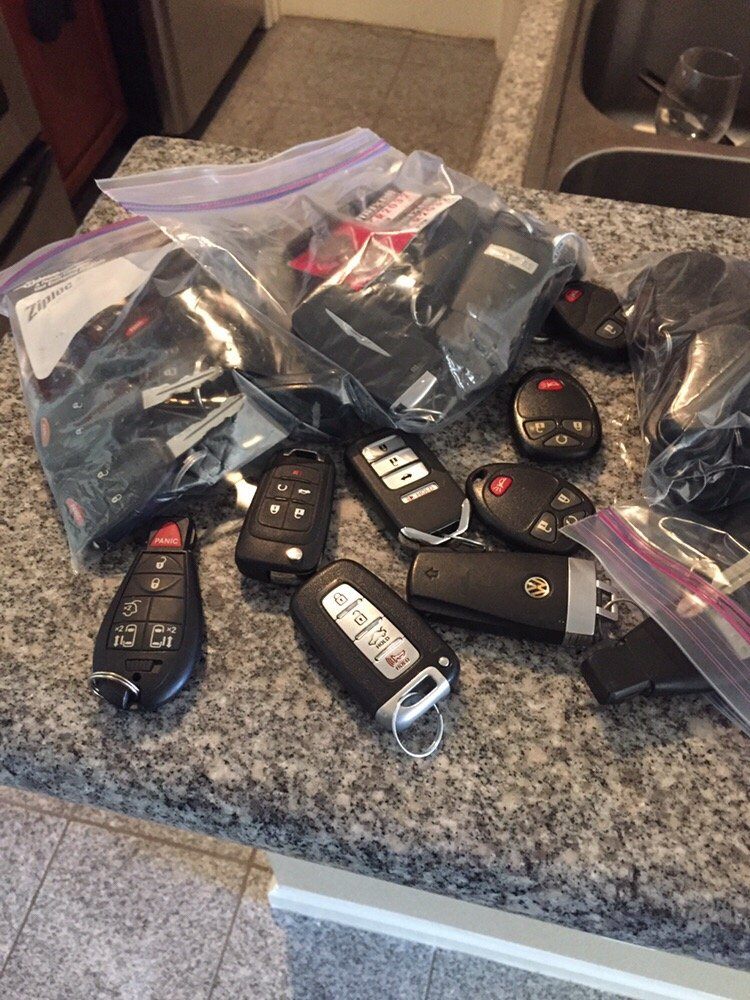
How car keys work today
A modern car key does two jobs. The first job is mechanical or radio: the blade turns the lock, or the proximity fob lets the car know you are close. The second job is electronic: a security chip inside the key has to answer the car’s immobilizer with the right code, or the engine will not run.
That second job is why a copy cut at a hardware counter often turns the ignition and still leaves the car silent. The blade is only half the key. The car has to be taught to accept the new chip, and that takes professional programming equipment.
Over the last twenty years the systems have grown more layered. Early chip keys used a simple handshake. Later systems use codes that change, modules that are paired to one car, and manufacturer servers that must approve a new key. We explain each layer in plain English on the pages linked below.
The main key types
Whatever the make, nearly every key on the road today falls into one of six types. Each has its own page with details, and each is handled a little differently.
Standard keys without a chip
These are the older all-metal keys with no electronics. They are rare on newer cars, but they still show up on older vehicles, trucks and work vans. Our page on standard keys without a chip explains how they are cut and why they are the simplest job in the trade.
Transponder keys
A transponder key has a chip hidden in the plastic head. The chip carries no battery. It is powered by the car when the key is near the ignition. Read our guide to transponder keys for how the handshake works and why programming is required.
Remote head keys
A remote head key combines the blade, the chip and the lock and unlock buttons in one piece. See remote head keys for how these are repaired, replaced and paired with the car.
Flip keys
A flip key folds its blade into the fob like a pocketknife. They are popular, and the hinge and spring are the parts that wear out. Our page on flip keys covers repair and replacement.
Laser cut and high security keys
These keys have a wavy track milled into the side of the blade instead of cuts on the edge. They are harder to pick and harder to copy, and they need a special machine. See laser cut and high security keys for details.
Push to start smart keys
A smart key lets you unlock and start the car with the fob in your pocket. Our guide to push to start smart keys explains how they work and what makes them the most complicated key to replace.
Key words you will hear, in plain English
Locksmith talk can sound like a foreign language, so here is a short glossary. The immobilizer is the part of the car that decides whether the engine may run. The transponder is the chip in your key that answers the immobilizer. Together they stop a car from starting with a key that was merely cut to fit. A proximity key, also called a smart key, is a fob that works from a pocket or bag, with a push button on the dash to start the car. Once those words are clear, the rest falls into place.
Three more terms come up often. The emergency blade is the small metal key hidden inside a smart fob, used for the door if the battery dies. Programming is the step that introduces a new key to the car, and it is separate from cutting the blade. A security delay or a server registration is a waiting period or manufacturer approval that some makes require before they accept a new key. We describe how these apply to each brand on its own page. We explain each one again, in context, whenever it applies to your car.
Why does vocabulary matter? Because it helps you ask the right question. If someone says a key is cut but not programmed, you now know the ignition may turn and the engine will still not run. If someone says a key needs server registration, you know the job depends on the manufacturer, not only on the tools. And if a listing online says a key fits every model of a car, you know to call us with the VIN before you buy. A little vocabulary protects you from paying for the wrong thing, and it makes any call with us shorter and clearer for everyone involved.
How to tell which key you have
Start with how the car starts. If you turn a key in a slot, you have a blade key of some kind. If you press a button on the dash while the key stays in your pocket or bag, you have a smart key. Some cars have a dash slot where a rectangular fob is inserted, and these sit between the two.
Next, look at the key head. A thick plastic head usually means a chip is inside. Buttons on the head mean a remote head key. A blade that folds out is a flip key. A blade with a wide wavy channel down the middle or side is a laser cut key.
If you still cannot tell, send us a photo and the VIN. We can identify the key from those two things, and we confirm it again by looking at the car before we cut or program anything. Two cars of the same model and year can use different keys, depending on trim and options.
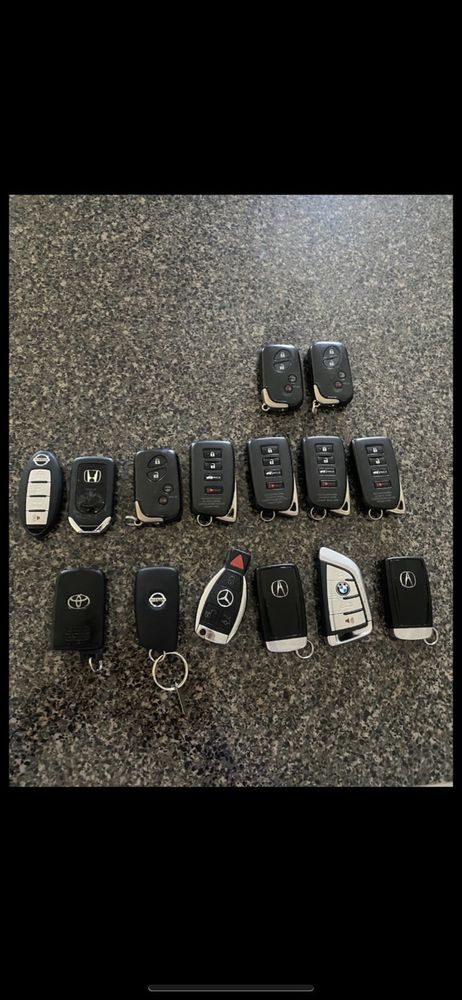
American brands: GM, Ford and Stellantis
General Motors vehicles include Chevrolet, GMC, Buick and Cadillac. These brands share a lot of key technology, so what you learn about one often applies to the others. Newer models need dealer-level tools and communication with the manufacturer’s servers.
Ford and its luxury brand Lincoln have their own history. Ford replaced an old security delay routine with manufacturer credentials on newer models, which is why newer Fords are dealer-level work. Two Ford blades can look the same and use different chips, so a correctly cut wrong blade turns the ignition and will not start the car.
The Stellantis family covers Chrysler, Dodge, Jeep and Ram. These brands share key families and security systems across models, but the details vary by model and year. Each page walks through what we see on the road, from older trucks with simple transponder keys to newer models with push-button start. When you read those pages, pay attention to the notes about trims, because the same model can be sold with more than one key.
Japanese brands
Toyota and Lexus changed their chip systems model by model, not in a single year. A Corolla changed earlier than a Camry, for example, so we never assume from the brand alone. On newer smart key systems, an immobilizer reset can erase every key that is not present, so bring every key you own.
Honda and Acura share technology. On both, an all keys lost job also removes the old keys from the car’s memory, which is useful if a key was stolen and important to know if you still have another one.
Nissan and Infiniti share their key families as well, and newer models need dealer-level tools and manufacturer server contact. Mazda, Mitsubishi and Subaru each have their own pages, with a mix of transponder, flip and smart keys depending on the model and the year.
Call Pro Locksmith at (954) 406-8266. Tell us the year, make and model and where the car is parked, and we will confirm what your vehicle needs before any work starts.
Korean brands
Hyundai and Kia are closely related and often use similar keys. Flip keys and smart keys are common. On newer models the key has to be obtained through the dealer before we can perform the required programming, and our make pages say so clearly.
Hyundai and Kia are popular as rental and fleet cars in South Florida, and as used cars. That means many arrive with a single key. If you bought one used or from a rental sale, a spare is a smart first step.
German and European brands
European makes are where key hardware varies the most. BMW keys follow the security module generation, from diamond keys to slot-in fobs to proximity keys and Display Keys, and Mini belongs to the same family. Mercedes-Benz uses two main key systems. The older one ends and the newer one begins roughly between 2012 and 2017, depending on the chassis. The newer one needs manufacturer server registration for a new key.
Audi and Volkswagen share Volkswagen Group designs. Advanced Key and keyless start are not always the same on Audi, and on both makes newer cars require the key to be ordered through the dealer first.
Volvo and Land Rover round out the group. Newer Volvo and Land Rover models need dealer-level programming tools. Each page lists exactly what applies and what we can do. These are also the brands where a used car from another market can surprise you, so tell us if the car was not bought new in the United States.
Lost all keys versus adding a spare
These are two different jobs. A spare is made while you still have a working key. The car can be asked to learn a new one with less effort. An all keys lost job starts from nothing: we confirm ownership, identify the key from the VIN, cut the blade if needed and program a key to a car that has no working key to introduce us.
All keys lost is almost always more involved than adding a spare. On some cars the difference is small. On others it is large, and on a few it is the difference between a roadside job and a dealer job. This is why we encourage a spare as soon as you buy a car.
Our pages on lost all key service and lost all car keys replacement describe the process in detail, and car key replacement and programming shows how it compares with making a spare.
Newer cars and dealer-level limits
The newest cars are changing how keys are made. Many manufacturers now require tools that connect to their own servers, and some will only release a key through a dealer. We work under those limits, and we are honest about them.
Each make page on this site has a Dealer-level requirements box that lists the exact model years and what applies. We do not repeat those details here because they differ by manufacturer, and a general statement would be less accurate than the specific box.
If your car is new enough that a dealer step is involved, we can still help. We tell you what the dealer needs from you, and once the key arrives we handle the programming where the manufacturer allows it.
What we need from you
We need proof that the car is yours and a way to identify it. Proof can be a registration, a title or a lease together with a matching photo ID. If a business owns the car, a letter from the business plus your ID is the usual route.
To identify the car we use the VIN, found on the lower driver corner of the windshield and on the driver door jamb. We then look at the vehicle itself, because the VIN tells us the model and the year, and the dash and doors tell us the rest.
Please gather every key you still have, even a worn or broken one. Extra keys can help the programming, and on some cars all the keys must be present at the same time.
How a visit works
You call and tell us the make, model, year and where the car is. We explain what we need and what the job involves. A technician then drives to your location: a home, an office, a parking garage or the roadside.
At the car, we confirm ownership, identify the key, cut the blade if needed and program the key to the car. We test the remote, the locks, the trunk and the engine start before we leave. We also test the old keys, since some jobs change how they behave.
Before we finish, we show you how the key works, how to open the emergency blade on a smart key and what to do when a battery starts to fade. Read more on our automotive locksmith page.
What South Florida does to car keys
Heat is the main enemy. A key left on a dashboard in summer can warp its case, drain its battery and wear out its buttons. Park with the key out of the sun when you can.
Humidity and salt air corrode contacts and coin cells, especially for people who live near the coast in Hollywood, Pompano Beach, Boca Raton or Miami. A fob that gets wet in a pocket after a beach or boat day can start to fail weeks later.
South Florida also has a large share of rental cars, fleet cars, used cars and snowbird cars. Many of them have one key and no history. A snowbird car that has sat for months often wakes up with a dead key battery and a dead car battery at the same time.
Broken keys, worn ignitions and lockouts
Not every key problem is a lost key. A key can snap in the ignition or in a door, and a worn ignition can stop a good key from turning. We can extract the broken piece, repair or replace the ignition and cut a new key. See broken key extraction for the process.
If you are locked out, our car lockout service opens the car without damaging the paint or the weather stripping. Please tell us if a child or a pet is inside, and we will plan accordingly.
Fob and battery care
Most fob batteries last a couple of years. If the buttons need two presses, the range drops or the dash shows a key warning, change the battery early. A fresh battery solves many no-start and no-entry calls.
Keep fobs dry and away from heavy impacts. A large bunch of keys hanging from an ignition key wears the ignition over time, so split the car key off. Keep a spare at home, not in the glove box.
Know where the emergency blade is on your smart key, and how to release it. We show owners this at the end of every visit.
Repair, shell swap or full replacement? Choosing the right fix
Not every worn key needs replacing. Before you commit, work out what has actually failed. If the buttons are sluggish or the range has dropped, a new battery may be all you need. If the rubber pads are worn through or the case has cracked, a new shell may solve the problem and keep the electronics you already have. If the key does not start the car at all, the chip or its programming is more likely at fault, and that points to a replacement. The right answer depends on the key in your hand.
A hinge is the usual failure on a flip key, and the spring or pin gives out long before the electronics. A blade can also bend or wear until it sticks in the ignition. In those cases the repair path can be shorter than starting over. Be careful with shell swaps on some cars, since the chip may sit in a part that must move with the blade. We check where the chip lives on your key before we suggest a swap, and we say so if it is not worth doing.
Replacement makes sense when the key is badly damaged, when the car refuses it, or when it is the last one you own. In that case, ask us for a key plus a spare, so the job leaves you with two working keys. We look at the key, the VIN and the car, and tell you honestly which of the three options fits. Sometimes the simplest fix for you is the smallest one, and we would rather say so than sell more than the situation calls for. Every key we leave behind should be one you can trust.
Before you buy a key online
Online listings promise keys that fit a whole range of cars. In practice, keys differ by year, trim, option and market. A used fob can also be locked to the car it came from, which makes it useless on yours.
Before you spend money, call us with your VIN. We can tell you which key suits your car, and we can supply and program it, so that nothing you buy turns out to be wasted. Our page on key programming explains how a new key is introduced to a car.
Serving Broward, Miami-Dade and Palm Beach
We are based in Fort Lauderdale. Our technicians drive to customers across Broward County, Miami-Dade County and Palm Beach County, including Hollywood, Pembroke Pines, Coral Springs, Plantation, Pompano Beach, Boca Raton, Miami and West Palm Beach.
Tell us the address and whether the car is in a garage or a gated community, and we plan the visit around it.
Common questions
How do I know what kind of car key I have?
Look at how the car starts and what the key head looks like. A key turned in a slot is a blade key, a button on the dash with the key in your pocket is a smart key, and a thick plastic head usually hides a chip. Send us a photo and the VIN and we will confirm it before we ever drive out, so you know the plan in advance.
Can you make a car key without the original?
For most makes, yes. We confirm that the car is yours, identify the key from the VIN, cut the blade where needed and program the new key at your car. Some newer makes need dealer-level steps, and we say so before we begin. Each make page lists what applies, and our technician will tell you plainly at the start if your car is one of the exceptions.
Why won’t my new key start the car?
The blade may be cut correctly while the chip inside the key has not been introduced to the car. The ignition only needs the metal shape to turn, while the engine needs the chip to answer with the right code. Programming fixes this, so please stop trying to start the car. Repeated cranking only drains the battery and does not help the new key.
Is it better to have a spare made before I lose my key?
Yes, and the sooner the better. A spare is much easier than a rescue because the car can learn a second key when one working key exists. On many cars an all keys lost job is a much bigger operation. Keep the spare at home or with a trusted relative, not in the car, so it does not leave with the car if the car is ever stolen.
Do you come to me?
We come to you. A technician drives to your home, workplace, garage or roadside across Broward, Miami-Dade and Palm Beach counties. The cutting and programming equipment travels with us in the van, so the work happens right beside your car, and most jobs do not need a tow or a trip to the dealer, which saves you a lot of time.
Do newer cars need the dealer?
Some do, mostly the newest models. Several manufacturers now require tools that connect to their own servers, or only release keys through a dealer. Each make page has a Dealer-level requirements box that lists what applies. We tell you before you commit and help you prepare for the dealer visit, including the paperwork they will ask for.
What do you need from me before you start?
We need proof that the car is yours, such as a registration, title or lease with a matching photo ID, and the VIN so we can identify the car. Please bring every key you still have, even broken ones, because on some cars all keys must be present at the same time to be programmed.
Which areas do you serve?
We are based in Fort Lauderdale and travel across Broward, Miami-Dade and Palm Beach counties, including Hollywood, Pembroke Pines, Coral Springs, Plantation, Pompano Beach, Boca Raton, Miami and West Palm Beach. Tell us where the car is, and whether it is in a garage or a gated community, and we plan the visit around it.
Call Pro Locksmith at (954) 406-8266. Tell us the year, make and model and where the car is parked, and we will confirm what your vehicle needs before any work starts.