

Ford has used plain metal keys, chipped transponder keys, flip keys and push-button smart keys, and the right fix depends on which one your vehicle has. We come to your Ford anywhere in Broward, Miami-Dade and Palm Beach, work out the key type, and explain what the job involves.

How Ford keys have changed over the years
Ford keys fall into a few clear eras, and knowing which era your vehicle belongs to is the first step in any key job. Before the late 1990s, most Fords used a plain metal key with no electronics at all. If the blade fit the lock, the engine started, and a copy from any hardware counter would do.
That changed when Ford introduced PATS, short for Passive Anti-Theft System, on most models around the 1999 model year. From then on a small chip hidden in the plastic head of the key had to talk to the car before the engine would run. A key that was cut perfectly but carried no matching chip would turn the ignition and still leave you with a silent engine.
Over the next two decades the chips got more sophisticated and the key shapes changed. Plastic-head transponder keys gave way to remote-head keys and flip keys with high-security blades, and from about 2015 push-button start smart keys with a hidden emergency blade became common. On the newest Fords the security rules changed again, which is why a page like this has to separate the older vehicles from the newer ones. The model list on this page shows the typical key type by model and year range.
- Before about 1999: plain metal keys on most models
- About 1999 onward: PATS chip keys in plastic heads
- About 2015 onward: high-security flip keys and push-button smart keys
- Newer models: manufacturer-level security that limits which tools can program a key
What Ford owners in South Florida usually run into
South Florida is hard on keys, and Fords are everywhere here, from F-150 work trucks to Escapes, Explorers, Mustangs and Transit vans. We see the same handful of situations again and again, and most of them are easy to prevent once you know what is behind them.
Heat and humidity
A key left on a dashboard or in a cup holder in July can bake for hours. Heat weakens the glue and solder inside a remote-head key, and humidity creeps into the case and corrodes the battery contacts. A fob that works one week and fails the next is often a victim of exactly this.
Salt air near the coast
If you live or work near the beach, in Fort Lauderdale, Hollywood, Pompano Beach or Boca Raton, salt in the air settles on metal. Ignition cylinders get gritty, door locks stiffen, and keys wear faster. A key that has started to feel rough going into the ignition is giving you a warning.
Rental, fleet and used vehicles
Ford vans, pickups and Crown Victoria style sedans have long been popular as fleet and service vehicles. Fleet keys get passed between drivers, lost at job sites and copied without records. Used-car buyers often get one key at purchase, which is a gamble if that single key is the only one in existence.
Snowbird vehicles
Many Fords sit for months while their owners are up north. A weak battery and a long idle period can leave a fob unresponsive or a vehicle that will not recognize its key. When the owner returns in the fall, a spare key is the last thing on the list until the only key goes missing.
Ford models, years and key types
This list shows the key systems we commonly see on Ford vehicles in South Florida, grouped by model and model year range. Key type can change by trim level and production date within a range, so we always confirm the exact key from your VIN and the car itself before cutting or programming anything.
| Years | Key type | Notes | |
|---|---|---|---|
| F-150 | |||
| 2000 to 2003 | Transponder key | First F-150 transponder key. Remote is a separate fob. | |
| 2004 to 2014 | Transponder key | Many trucks have a separate keyless-entry remote instead of a remote-head key. | |
| 2015 to 2020 | Flip key | Flip key on key-start trucks, smart key on push-button start trucks. | |
| 2021 to 2025 | Push to start smart key | Programming on these trucks needs updated tools. (varies by trim) | |
| F-250 and F-350 Super Duty | |||
| 2000 to 2003 | Transponder key | Shares the transponder system with the F-150 of the same period. (varies by trim) | |
| 2004 to 2016 | Transponder key | Same key family as the F-150 of the period. (varies by trim) | |
| 2017 to 2025 | Flip key | Confirm the key type by looking at the ignition. (varies by trim) | |
| Explorer | |||
| 2000 to 2010 | Transponder key | PATS transponder system. (varies by trim) | |
| 2011 to 2019 | Flip key | Smart key was available on higher trims. (varies by trim) | |
| 2020 to 2025 | Push to start smart key | Push-button start on the redesigned Explorer. (varies by trim) | |
| Escape | |||
| 2001 to 2004 | Transponder key | First generation Escape. (varies by trim) | |
| 2005 to 2012 | Remote head key | Some trims use a transponder key with a separate remote. (varies by trim) | |
| 2013 to 2019 | Flip key | Check the ignition type before ordering. (varies by trim) | |
| 2020 to 2025 | Push to start smart key | Push-button start. (varies by trim) | |
| Edge | |||
| 2007 to 2014 | Remote head key | Push-button start was available on higher trims. (varies by trim) | |
| 2015 to 2024 | Push to start smart key | Hidden emergency blade in the smart key. (varies by trim) | |
| Fusion | |||
| 2006 to 2012 | Remote head key | Check the ignition type before ordering. (varies by trim) | |
| 2013 to 2020 | Flip key | High-security blade. (varies by trim) | |
| Focus | |||
| 2000 to 2011 | Transponder key | PATS transponder system. (varies by trim) | |
| 2012 to 2018 | Flip key | Smart key was available on higher trims. (varies by trim) | |
| Mustang | |||
| 2000 to 2014 | Transponder key | PATS transponder system. (varies by trim) | |
| 2015 to 2025 | Flip key | Most newer Mustangs are push-button start. (varies by trim) | |
| Expedition | |||
| 2000 to 2017 | Transponder key | Smart key option on some later trims. (varies by trim) | |
| 2018 to 2025 | Push to start smart key | Push-button start. (varies by trim) | |
| Ranger | |||
| 2000 to 2011 | Transponder key | The Ranger was not sold in the US for 2012 to 2018. (varies by trim) | |
| 2019 to 2025 | Flip key | Relaunched for the 2019 model year. (varies by trim) | |
| Fiesta | |||
| 2011 to 2019 | Flip key | Subcompact sold in the US for 2011 to 2019. (varies by trim) | |
| Taurus | |||
| 2000 to 2007 | Transponder key | Name was dropped for 2008 and 2009 (Five Hundred era). (varies by trim) | |
| 2010 to 2019 | Push to start smart key | Check the ignition type before ordering. (varies by trim) | |
| Crown Victoria | |||
| 2000 to 2011 | Transponder key | Common taxi and fleet car, same key system through its run. (varies by trim) | |
| Transit | |||
| 2015 to 2025 | Flip key | Check ignition type on newer vans. (varies by trim) | |
| Bronco Sport | |||
| 2021 to 2025 | Push to start smart key | New for the 2021 model year. (varies by trim) | |
Dealer-level requirements for Ford
Ford vehicles manufactured from 2021 through 2026 require dealer-level tools and communication with Ford’s servers. Pricing starts at $600. Final pricing depends on the vehicle and whether one or two keys are required. Programming takes approximately two to three hours. Completion time may vary depending on the availability and response time of Ford’s servers.
Plain metal keys on older Fords
Some older Fords, especially vehicles from before the late 1990s, use a plain metal key with no chip. These are the simplest keys to replace, and we can cut one on site once we confirm the lock. Even so, we do not guess. We look at the lock, confirm the vehicle by its VIN, and cut the key to match.
If an old Ford will not start with a freshly cut plain key, the problem is usually not the key. It can be a worn ignition cylinder, a bad starter circuit or a dead battery. We check those before we blame the key. You can read more about how these simpler keys work on our page for standard keys without a chip.
PATS transponder keys: the long-running Ford chip key
From about 1999 until the middle of the 2010s, most Fords used a transponder key with a plastic head. Inside that head is a chip that answers the car when you turn the key. The first PATS keys on F-Series trucks used one chip type, and from about 2004 many F-Series trucks and other Fords moved to a stronger chip that stayed in service for roughly a decade.
These keys come in a few forms. Some are plain transponder keys with a separate keyless-entry remote. Others are remote-head keys where the buttons sit in the head. Which form your vehicle has depends on the model, the year and often the trim, so we confirm it by VIN and by looking at the car before we order or cut anything. For more on how this key family works, see our page on transponder keys.
Why a wrong blade looks right but fails
Two Ford blades can look the same to the eye and still carry different chips. A key cut perfectly to the wrong blade will turn the ignition and may even run the dash lights, but the engine will not start because the chip does not belong to that system. We have seen drivers spend money on a key that looked perfect and never worked. That is why we match the blade and the chip to your vehicle before we cut.

Remote-head keys and separate remotes
Many Fords from the 2000s and early 2010s use a remote-head key, where the lock, unlock and panic buttons are part of the key head. Others use a plain transponder key plus a separate keyless remote. The two are programmed differently. The chip in the key is learned by the car to allow starting, while the remote buttons are learned separately to allow locking and unlocking.
This is a common source of confusion. A driver loses a remote and assumes the car will not start, when really only the convenience buttons are gone. Or the opposite happens, and a driver replaces the remote but the engine still will not start because the chip key was never addressed. We sort out which one you actually need. Our page on remote head keys explains the style in more detail.
Flip keys and high-security blades
From about 2015, many Fords began using flip keys with a high-security blade cut into the side of the blade rather than along its edge. The blade folds into the fob, and the key also carries a stronger chip than the older PATS keys. On models that still use a key in the ignition, a flip key is common. On push-button start models the same style of blade often appears as the hidden emergency key inside the smart key.
High-security blades take special cutting equipment, which is why a hardware store cannot copy them. A mobile technician who carries the right machine can cut one at your vehicle. We cover this key family on our page about laser cut high security keys. If your key has a wavy track milled into the blade, this is likely your key.
Call Pro Locksmith at (954) 406-8266. Tell us the year, make and model and where the car is parked, and we will confirm what your vehicle needs before any work starts.
Push-button Intelligent Access smart keys
Ford calls its smart key system Intelligent Access. The fob stays in your pocket or purse, the doors unlock when you touch the handle, and the engine starts with a button. Inside the fob is a hidden emergency blade that lets you open the driver’s door if the battery dies. This system became common on Fords from about 2015 and is standard on most newer models.
Programming a smart key is more involved than programming a chip key. The vehicle has to authenticate the new fob, and on newer Fords that authentication depends on tools and credentials that only certain providers can use. The model list on this page shows which models typically use a smart key. For a closer look at the technology, see our page on push-to-start smart keys.
- Hold the fob close to the start button if the battery is weak
- Use the hidden blade to open the driver’s door
- Replace the fob battery before the fob stops working
- Bring every fob you own to the appointment
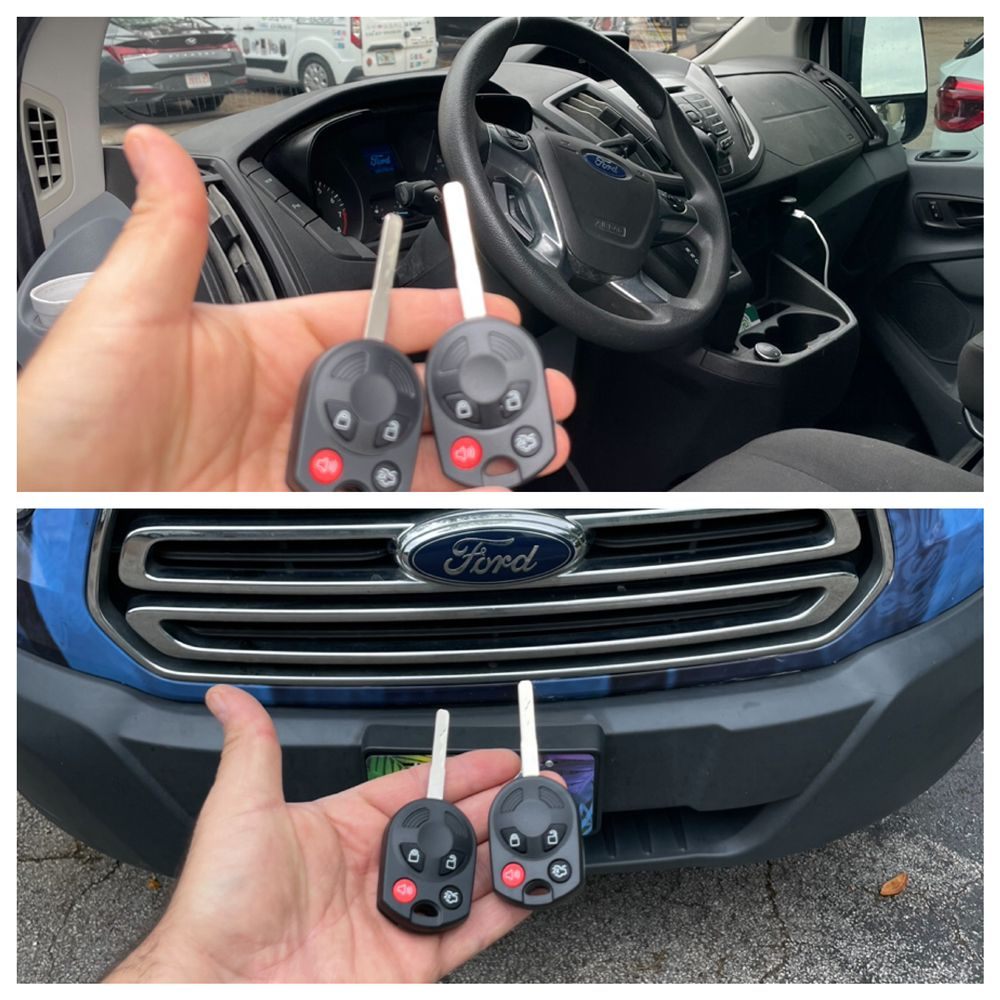
All keys lost versus adding a spare
These are two different jobs, and the cost, time and complexity can differ a lot. Adding a spare means you still have a working key. The vehicle can be programmed to accept a new one while the existing key is available, and in many cases it is the simpler of the two jobs.
All keys lost means no working key remains. The car has to be told to forget the old keys and accept new ones, and on newer vehicles that step requires more access than a simple programming session. A lost-key job also takes more time because the blade must often be cut from the lock or the VIN before programming begins.
The practical advice is simple. If you have only one key, make a spare today. Waiting until the last key is gone turns a small job into a larger one. Our page on lost all keys service explains the process, and our car key replacement and programming page covers the full range of work.
Newer Fords and manufacturer security
For many years Ford allowed a technician to program a new key by turning the ignition on and off in a sequence and then waiting through a security delay of about ten minutes. That approach ended as Ford changed its security from about the 2020 model year, depending on the model. Newer vehicles now require manufacturer credentials and communication with the manufacturer’s systems before a new key can be added.
This is why a 2018 Ford and a 2022 Ford of the same model can need very different handling. The older vehicle may be a straightforward on-site programming job. The newer one may need dealer-level tools, and the exact steps depend on the model.
We tell you plainly which side of that line your Ford falls on, usually before we drive out. The box on this page lists the dealer-level requirements we work under, so read it before you plan a newer vehicle. If you are not sure, tell us the year, the model and whether the vehicle has a start button, and we will explain what applies.
What we need from you
Key work is security work, so we ask for proof that the vehicle is yours. This protects you as well as us. A locksmith who makes a key for anyone who asks is a locksmith who helps car thieves.
We typically ask for a government photo ID and one document that ties you to the vehicle, such as the registration, the title or a lease or insurance document in your name. We also need the VIN, which appears on the dashboard near the windshield and on the driver’s door jamb. If you are working with a business or fleet, an authorization from the company is the usual substitute.
- Photo ID that matches the ownership document
- Registration, title or lease paperwork for the vehicle
- The VIN, or access to the dashboard so we can read it
- Every key and fob you still have, even broken ones
How a visit works
You call, tell us the year, make and model, and describe what happened. We ask whether the vehicle has a keyed ignition or a start button, and whether you have any working key. With that, we can usually tell you what the job will involve and whether a newer vehicle needs dealer-level steps.
A technician then comes to your vehicle at home, at work or wherever it is parked in Broward, Miami-Dade or Palm Beach. We check your ownership proof, confirm the VIN, and identify the key type by looking at the ignition and the existing key. If a blade must be cut, we cut it on site. Then we program the new key or fob and test it fully before we leave: starting the engine, the remote buttons and the door locks.
We do not ask you to take the vehicle anywhere. The work happens where the vehicle sits, which matters most when the vehicle will not start and cannot be driven.
What makes Ford keys tricky
Fords look simple from the outside, but a few details catch people out. Knowing them helps you avoid buying a key that will not work.
- Blades that look identical but carry different chips, so a correctly cut wrong blade will not start the car
- The same model can use different key styles from one year to the next, and sometimes from one trim to the next
- Trucks and SUVs can share a model name across generations that use completely different keys
- Smart keys that look like each other but belong to different systems and cannot be swapped
- Online keys that are sold as compatible but are locked to another vehicle or to another system
- Newer models that cannot be programmed by the old ignition-sequence method
Work trucks, vans and fleet Fords
A large share of the Fords on South Florida roads are work vehicles. F-150, F-250 and F-350 trucks, Transit vans, Rangers and older Crown Victoria style sedans all spend hard hours on jobsites, delivery routes and taxi stands. These vehicles lose keys more often than family cars because many hands touch them and keys end up in pockets, toolboxes and drains.
If you run a fleet, the smartest habit is to keep a documented spare for every vehicle in a locked place, and to replace keys before the last one is gone. When a fleet vehicle is down, every hour costs money, and an all keys lost job on a work truck is always more disruptive than a planned spare. We can program several keys in the same visit, which saves a second trip.
When a driver quits and a key goes with them, you may want the old key removed from the vehicle’s memory. Ask us about that when we program your new keys. On many Fords we can make the car forget keys that are no longer wanted, which is useful when an employee leaves without returning a key.
Fob care, batteries and warning signs
Most fob failures are small and can be fixed before they become a service call. A weak battery is the most common cause. If the range of your remote has dropped, or you have to press the button several times, replace the battery before it dies completely.
Keep the fob out of direct sun, away from water, and off the dashboard. Do not put a heavy ring of keys on the ignition, since the weight wears the cylinder over time. Wipe the metal blade now and then, and if you live near the coast, avoid leaving keys in a damp bag or a wet pocket.
A key that sticks, a fob that works only when you hold it in a certain position, or a dashboard light that flickers when you start are all early signs. Fixing them early almost always costs less than waiting for the failure.
- Replace fob batteries when the range drops
- Keep a spare key in a safe place at home
- Avoid leaving keys in a hot car or a damp bag
- Have the ignition checked if the key feels rough
When a dealer visit might be needed
Some Fords cannot be handled by a mobile locksmith. On the newest models, the manufacturer controls the security data, and a new key must be ordered or authorized through the dealer. We tell you this up front rather than sending you in circles.
In those cases we may still be able to help. The dealer-level box on this page describes what we can do once the right key and authorization are in hand. We also help with the other parts of the problem, such as getting into a locked vehicle, removing a broken key or repairing a worn ignition, which a dealer visit does not solve. For lockouts see our page on car lockout service, and for broken keys we also offer extraction.
Common questions
Can you make a key for my Ford if I lost every key?
In many cases yes, especially on older Fords. We confirm the VIN, cut the blade and program the new key at your vehicle. On the newest Ford models the manufacturer controls the security data, so the job may need dealer-level steps. Tell us the year, model and whether you have a start button, and we will explain what applies before you commit to anything.
Why won’t my Ford start with a new key that turns the ignition?
This usually means the chip in the key does not match your vehicle. Some Ford blades look identical but carry different chips, so a key can be cut perfectly and still fail to start the engine. The key must be programmed to the car, and the correct chip must be used. We match the key to your VIN before we cut or program anything.
Do I need to bring my old key?
Bring every key and fob you still have, even broken or worn ones. They help us identify the exact style and sometimes make the job simpler. If you have no key at all, that is fine too, but it is an all keys lost job and may take more time. We will tell you what applies once we know the year and model.
What is the difference between a spare key and a lost key job?
A spare key job happens while you still have a working key, so the car can accept a new one without erasing anything. A lost key job means no working key remains, so the system must be reset and new keys introduced. That takes more time and, on newer Fords, more access. Making a spare early is almost always simpler.
Can a Ford smart key be programmed at my location?
On many older smart key Fords, yes. We come to the vehicle and program the new fob there. On newer models, programming depends on manufacturer-level security, so some jobs need dealer-level tools. The dealer-level box on this page explains what we work under, and we will tell you plainly which side your vehicle falls on.
Will you ask for proof that the vehicle is mine?
Yes. We ask for a photo ID and a document that ties you to the vehicle, such as registration, title, a lease or an insurance card, plus the VIN. This protects you and keeps thieves from getting keys made. For a business or fleet vehicle, a written authorization from the company works in place of personal ownership.
Should I make a spare Ford key before I lose the last one?
Yes, and it is the biggest money saver in key work. Adding a spare while you still have a working key is simpler than a lost key job. In South Florida, heat, humidity and salt air wear keys faster, so a spare in a safe place at home is a smart habit. Ask us to program two at once.
Can you remove an old Ford key from the car’s memory?
On many Fords we can make the car accept only the keys you choose, which is useful after a key is lost or an employee leaves without returning one. Whether this is possible depends on the year and model. When we program your new keys, ask us, and we will tell you what the vehicle allows.
Call Pro Locksmith at (954) 406-8266. Tell us the year, make and model and where the car is parked, and we will confirm what your vehicle needs before any work starts.