

A laser cut key, also called a sidewinder or high security key, has a wavy track milled into the flat of the blade instead of teeth along the edge. It resists copying and picking, but it needs special machines. We cut and program these keys at your car across South Florida.
What makes a key laser cut or high security
Look at an old house key and you will see teeth cut along the top or bottom edge. A laser cut key looks different. The blade is thicker, the edges are usually smooth, and the cuts are a winding groove milled into the flat face of the blade. Some keys have the groove on both sides. Locksmiths call this style sidewinder, internal cut or high security, depending on who you ask.
The name laser cut is a little misleading, because the groove is cut by a small milling bit, not a laser. The name stuck because the cut has a laser-precise look. What matters is that the lock inside the car has a set of small wafers or pins that ride in that groove, and the groove has to be correct to a very fine tolerance.
These keys were created to make cars harder to steal. The track is difficult to copy on a basic machine, hard to pick, and harder to wear down by sloppy duplication. In the car world they became common from the mid 2000s onward and are now everywhere.
Why car makers moved to this blade style
There were two reasons. The first was theft. Edge-cut keys can be copied with simple tracing machines, and their locks can be opened by skilled picking. A milled track is less forgiving, and the lock is built to match it.
The second reason was strength and consistency. A thicker blade with a cut in the middle is more rigid than a thin edge-cut blade, and it holds its shape longer. It also lets the maker use one blade shape across many models, which simplifies parts for them.
For owners, the benefit is a key that is more secure. The cost is that a duplicate is not a drop-in job at a hardware store kiosk. A wavy track needs a machine that can follow it, and the cut needs to be set up from a code or from a well-maintained original.
How a laser cut key differs from other key types
Laser cut describes the blade, not the electronics. That is the first thing to understand. A laser cut blade can be on a transponder key, on a flip key, on a remote head key, or hidden inside a push to start smart key as the emergency blade.
A plain standard key without a chip almost never has this style of blade. On the other hand, the blade does not by itself say anything about the chip. A laser cut blade can have a chip or, rarely, be a mechanical-only piece. Subaru service information, for example, notes that some of its edge-cut keys have a chip and some do not, while its laser cut keys all have an immobilizer.
So when you tell us you have a high security key, we still need to know what is inside. We confirm by VIN and by looking at the key, the ignition and how the car starts.
Makes and models that use laser cut blades
Our model data shows high security blades across many brands. On Ford, the move came in the middle of the 2010s. Ford’s own history in our data describes a high security blade with a more advanced chip on flip keys, and the same style of blade used as the hidden emergency blade in smart keys. That includes trucks like the F-150 and vans like the Transit, along with cars like the Escape and Fusion on key-start versions.
General Motors adopted the style in stages. The dossier we rely on dates GM’s first high security key to the mid 2000s, then Chevrolet and Buick flip keys around 2010, and then the Silverado and Sierra around 2014. Our data lists a Buick LaCrosse and Verano with a high security blade, a Cadillac Escalade and CTS, and a Chevrolet Tahoe, Suburban and Malibu, along with GMC Yukon models.
Land Rover used this style on models such as the LR3 and Range Rover Sport in the mid 2000s. Subaru is the clearest case of all: our data shows laser cut keys with a chip on Impreza and WRX models of roughly 2008 to 2011, on Forester from about 2009 to 2013, and on Legacy and Outback from about 2010 to 2014. Toyota’s Lexus side also uses a high security blade on many models, as do Honda and Acura on some keys.
Because many of these ranges are general and some trims differ, we treat every year range as a starting point. We confirm the real key on the car.
Sidewinder keys on Honda and Acura
Honda and Acura deserve their own mention because owners are often surprised by them. Our data notes that some 2000s Honda and Acura keys are sidewinder style and need a special cutting machine. It specifically names some Pilot and Odyssey keys from the early 2000s onward.
What this means in practice is that two Hondas of similar age can have different blades. One looks like an ordinary key with edge cuts. The other has a thick blade with a groove. If someone told you a Honda key is simple and then you were quoted a long wait, this is often the reason.
We carry the equipment to cut both styles, so you do not need to know which you have. You only need to tell us the make, model and year, and we do the rest.
Laser cut blades hidden inside smart keys
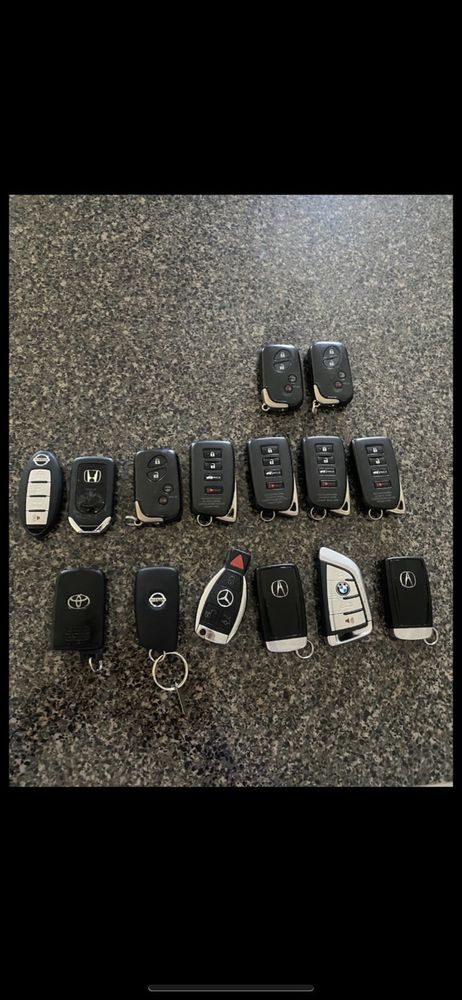
Even if your car starts with a button, you probably still own a laser cut blade. Most smart keys hide an emergency blade inside the fob. You slide a release and pull the blade out. On many cars that blade opens the driver door when the fob battery is dead, and some cars also use it for the glove box.
On BMW, Lincoln, Ford and other makes, that emergency blade is often a high security style. Our data on Lincoln notes the hidden blade is usually the same high security style as Ford’s. The dossiers describe many cars where the door keyhole is hidden under a small cap on the handle, so the blade has a real job to do, even though you may never have used it.
It is worth testing the blade before you need it. If your fob battery dies at a gas station in Hollywood, you want to be sure the hidden blade actually opens your door, and that you know where the keyhole is. If you have never found it, we can show you.
Call Pro Locksmith at (954) 406-8266. Tell us the year, make and model and where the car is parked, and we will confirm what your vehicle needs before any work starts.
Why duplicating a laser cut key is different
Copying an edge-cut key is a matter of tracing the teeth. Copying a laser cut key means following a groove, and the tool that follows it needs to be set up for that blade style. Not every key shop has one, and not every machine handles every style.
A second problem is that some keys have a track on both sides, or a track that is offset. If the machine is slightly off, the key may turn in the door but fail in the ignition, or the other way around. That is why we test each new key in every lock it needs to operate.
A third problem is that copying a worn key passes the wear on to the copy. High security locks are tight, and a worn key may hide the true pattern. When we can, we prefer to cut from the code that belongs to the car, which we can get through the VIN with proper authorization, or by reading the lock. The result is a crisp new key and not a copy of a copy.
Cutting from a code versus copying from a key
There are three ways to make a laser cut key. Which one applies depends on what you have.
If you still have a working key, we can copy it, or better, we can measure it and cut a fresh blade. If you have no key but we can verify ownership, we can often obtain the cutting information using the VIN and the car’s records through the proper channels. And if neither works, we can read the lock itself, which takes longer and is a skilled job.
- Copying a working key is the simplest, but it will pass on any wear in the original.
- Cutting from a code gives a clean blade that matches the factory pattern and usually gives the cleanest result when all keys are lost.
- Reading the lock is the fallback for cars where the code is not available, and it takes patience and the right tools.
- In every case we test the finished key in the door, the ignition and any other lock on the car.
The electronics still need programming
A new blade is only half of the work. If the key is a transponder, flip key, remote head or smart key, it also needs to be programmed to the car. Without that step, a correctly cut laser blade can turn the ignition and still not start the engine.
That is a point many owners find confusing. The key turns, the dash lights up, and then the engine does not catch. The mechanical side is right, but the car is waiting for its chip to answer. A shop that only cuts blades cannot fix that, and a shop that only programs chips cannot cut the blade. We do both at the car in a single visit.
For more on that side of the work, see our key programming page. For the full picture of how we handle replacements, see car key replacement and programming.
A common warning: the right blade on the wrong chip
One lesson from Ford applies widely. Two different Ford keys can have blades that look identical but use different chips. A correctly cut blade of the wrong family will turn the ignition and still refuse to start the car. We see the same story with other makes.
It is tempting to judge a key by the blade, because the blade is what you can see. But a laser cut blade tells you very little about what is inside the head. That is why we never order or cut a key by the shape of the blade alone.
We match the key to the car by VIN, trim and ignition type, and then verify before programming. It adds a few minutes to the job and prevents the most common mistake in this field.
What South Florida does to high security keys
The same salt air and humidity that damages remote buttons also affects blades. A thick laser cut blade holds up well, but the lock wafers inside the door and ignition can get sticky from dirt and corrosion. A key that used to glide may start to catch.
Heat plays a role too. Cars baking in a Miami parking lot can warm the plastic head of a flip key until it softens, which loosens the blade’s hold inside the housing. We see blades that wobble in the head after a few summers. If your blade moves, have it looked at before it snaps.
Beach and boat days are hard on keys. Sand in a lock is a real problem for a tight high security design. If your key feels gritty, do not force it. Contact us and we can clean and inspect the lock.
Broken blades and stuck keys
A laser cut blade is strong, but it can still snap, especially at the point where it joins the head, or in a worn lock. When the break leaves part of the blade inside the lock, the key cannot turn and the lock may not accept another key until the piece comes out.
We handle this with broken key extraction. Careful removal matters, because a high security lock has fine internal parts that can be damaged by a rough pull. After extraction, we check the lock, cut a new blade and program the electronics if needed.
If your blade is bent, cracked or loose in the head, do not wait for it to fail on a busy day. A new key is usually a simpler fix than a stuck lock.
All keys lost with a laser cut key
When every key is gone, a laser cut system can feel intimidating, but it is a job we do regularly. We identify the car from the VIN, find the cutting information through proper channels, cut the blade, and program a new key into the car’s memory.
On many vehicles the programming step removes the old keys from the car’s memory, which is useful if the lost keys could be misused. On some, it can also remove any key that is not present at the time, so bring every key you own if you have more than one. You can read more at lost all car keys replacement.
Newer vehicles from certain brands need dealer-level credentials or manufacturer server access for a new key. When that applies to your car, the dealer-level requirements box on this page explains what we can and cannot do. We tell you early, so you do not lose a day.
What we need from you and how the visit goes
We ask for a government photo ID and proof that the car is yours, such as the registration, title or insurance card, along with the VIN. This protects you and us, and it is standard in the trade.
We are a mobile service, so we come to your home, workplace, garage or roadside anywhere in Broward, Miami-Dade and Palm Beach counties. We look at the car and any keys you still have, explain the job, cut the blade, program the electronics, and test everything before we leave.
If you also need a spare, we make it in the same visit. A spare costs far less trouble than a second emergency, and with a laser cut key, having one on hand is especially wise.
Caring for a high security key
Treat the blade gently. Do not use it to pry, scrape or open packages. Avoid leaving it in a hot car or in direct sun, especially if it is a flip key with a plastic housing.
Keep the key ring light, because weight on a key hanging from the ignition wears both the key and the lock. If the key ever feels rough, tell us early. A polished new blade is a small job. A damaged ignition is a bigger one.
Keep a spare at home, away from the car, and make sure someone you trust knows where it is. If your car has a hidden emergency blade, test it once so you know how it works.
When a dealer visit might be needed
Most laser cut key jobs are handled by an automotive locksmith from start to finish. Some newer vehicles, however, require manufacturer access that only a dealer holds, such as online registration of the new key. Ford, for example, replaced its older security delay with manufacturer credentials from the 2020 model year, which is why many newer Fords are dealer-level.
The dealer-level requirements box on this page lists what we do and do not handle for each brand. If your car is recent and falls in one of those groups, we will say so on the phone. When a dealer is the right answer, we would rather tell you that than waste your time.
For the rest, call us with the make, model and year, and we can tell you what to expect.
Common questions
Is a laser cut key the same as a transponder key?
No. Laser cut describes the shape of the blade, with a wavy groove milled into the flat of it. Transponder describes the chip inside the head. Many keys are both, but a laser cut blade can be on a flip key, remote head key or smart key emergency blade, and we confirm which by looking at your car.
Why can’t any hardware store copy my car key?
A laser cut blade needs a machine that follows a groove in the flat of the blade, and many shops do not have one. Even when the blade is copied, the chip inside the key still has to be programmed to the car, which a basic key kiosk cannot do.
Can you cut a laser cut key if I lost all my keys?
Usually yes. With proof of ownership and the VIN, we obtain the cutting information through proper channels, cut a new blade and program the electronics. A few newer models need dealer-level access, which we explain up front. We test the new key in every lock before we leave.
My key turns the ignition but the car will not start. Why?
The blade is probably cut correctly but the chip is not recognized, or it is the wrong chip family. That is common when a key was bought online or copied without programming. We can test the chip, program the right one and confirm the key starts the car.
Does my smart key have a laser cut blade inside?
Most smart keys hide an emergency blade, and on many cars it is a high security style. It is meant to open the door when the fob battery is dead. We recommend testing it once and learning where your car hides the keyhole, so you are not guessing in the dark.
Can a worn laser cut key be copied again?
It can, but we prefer not to. A copy of a worn key passes on the wear, and high security locks are tight. When possible, we cut from the factory code so the new key is crisp and matches the lock. Copying is a fallback, not the first choice.
Do you handle Subaru, Ford, Honda and GM laser cut keys?
Yes, those are among the brands where this blade style is common. Our model data shows laser cut keys on Subaru, Ford, GM, Land Rover and others in certain years, and some Honda and Acura keys are sidewinder style. We confirm each one by VIN before cutting.
Call Pro Locksmith at (954) 406-8266. Tell us the year, make and model and where the car is parked, and we will confirm what your vehicle needs before any work starts.