

Toyota has used plain keys, transponder keys, remote head keys, flip keys and push button smart keys, often within the same model year. Pro Locksmith comes to your car in Broward, Miami-Dade and Palm Beach County and sorts out which key your Toyota actually needs.

A Plain English History of Toyota Keys
Toyota has built one of the most common fleets on South Florida roads, and that means we see almost every kind of Toyota key there is. The story starts simply. Very early or base vehicles used a plain metal key with no chip at all. By the early 2000s most Toyota models had moved to an immobilizer key, which is a metal blade with a small chip hidden in the plastic head. The car will not start unless the chip answers correctly.
Push button start came to Toyota in the middle of the 2000s, with the Prius and the Camry Hybrid among the first. Over the following years it spread across the lineup, until by the late 2010s most trims offered a proximity smart key. The important point for owners is that Toyota did not switch everything at once. A Corolla and a Camry from the same period may use different key systems, and two trims of the same model can differ again.
Why there is no single Toyota changeover year
The chip technology inside Toyota keys changed model by model, not in one big step. Some models moved to a newer generation earlier than others, and some carried an older system for years after a sibling model had moved on. This is why we never trust the model year alone. We confirm the key by VIN and by looking at the car before we cut or program anything.
What Toyota Owners in South Florida Run Into
Heat is the first enemy. A key fob that lives on a dashboard or in a hot cupholder will age faster than one kept in a cooler spot. Plastic cases crack, rubber buttons wear through, and batteries lose strength. Humidity and salt air add corrosion to battery contacts, especially for people who live near the water in Fort Lauderdale, Pompano Beach or Boca Raton and carry keys to the beach or the boat ramp.
Rental and fleet use is another local pattern. Toyotas are popular with rental companies and ride service drivers, and keys get passed around, dropped and lost at a higher rate. Used car purchases are also common here. A buyer often gets one key at the dealership and discovers later that the second key never existed. Snowbird cars sit unused for months, and a fob battery that has been dead since spring is a common reason a car seems to have a key problem when it does not.
- Worn or cracked fob cases from sun exposure
- Corroded battery contacts from humid or salty air
- Single key vehicles bought used
- Cars left parked for the summer by seasonal residents
- Keys lost at the beach, the marina or a parking garage
Toyota models, years and key types
This list shows the key systems we commonly see on Toyota vehicles in South Florida, grouped by model and model year range. Key type can change by trim level and production date within a range, so we always confirm the exact key from your VIN and the car itself before cutting or programming anything.
| Years | Key type | Notes | |
|---|---|---|---|
| Camry | |||
| 2000 to 2006 | Transponder key | Transponder key; a separate keyless remote was common on higher trims. Chip type changed during this period. (varies by trim) | |
| 2007 to 2011 | Remote head key | Most trims use a keyed ignition with a chip-equipped key or remote-head or flip key; smart key (push-button start) on Hybrid and some higher trims. | |
| 2012 to 2017 | Remote head key | Base trims keep a keyed ignition (remote-head or flip key); higher trims have a proximity smart key and push-button start. (varies by trim) | |
| 2018 to 2025 | Push to start smart key | Smart key on most trims. Some base trims may use a keyed ignition with a flip key. The 2025 redesign uses a new smart key. (varies by trim) | |
| Corolla | |||
| 2003 to 2008 | Transponder key | Separate transponder key with optional separate keyless remote. | |
| 2009 to 2013 | Transponder key | Transponder key, with a separate remote fob on many trims. (varies by trim) | |
| 2014 to 2018 | Remote head key | Remote-head key where the blade folds into the fob; smart key on some higher trims. (varies by trim) | |
| 2019 to 2025 | Push to start smart key | Smart key on push-button-start trims; base trims with a keyed ignition use a remote-head or flip key. Confirm by checking for a start button. | |
| RAV4 | |||
| 2001 to 2005 | Transponder key | Transponder key with a separate keyless remote. | |
| 2006 to 2012 | Remote head key | Remote-head key with built-in transponder on most trims. (varies by trim) | |
| 2013 to 2018 | Push to start smart key | Smart key and push-button start on Limited and higher trims; base LE keeps a remote-head key. | |
| 2019 to 2025 | Push to start smart key | Smart key standard on most trims including Hybrid and Prime. | |
| Highlander | |||
| 2001 to 2007 | Transponder key | Transponder key with an optional separate remote fob. | |
| 2008 to 2013 | Remote head key | Mostly remote-head keys; smart key on Limited and Hybrid trims. | |
| 2014 to 2019 | Push to start smart key | Remote-head key on base LE trims; smart key on XLE, Limited and Platinum. | |
| 2020 to 2025 | Push to start smart key | Smart key on most trims. | |
| Tacoma | |||
| 2000 to 2015 | Transponder key | Transponder key; a separate keyless remote on many trims. (varies by trim) | |
| 2016 to 2023 | Transponder key | Base trims with a keyed ignition use a transponder or remote-head key; push-button-start trims use a proximity smart key. (varies by trim) | |
| 2024 to 2025 | Push to start smart key | All-new generation; smart key with push-button start. (varies by trim) | |
| Tundra | |||
| 2000 to 2006 | Transponder key | Transponder key; a separate remote on some trims. (varies by trim) | |
| 2007 to 2021 | Transponder key | Keyed trims use a transponder key; higher trims offer a proximity smart key with push-button start. (varies by trim) | |
| 2022 to 2025 | Push to start smart key | All-new generation; smart key. (varies by trim) | |
| Sienna | |||
| 2000 to 2010 | Transponder key | Transponder key with a separate keyless remote on most trims. (varies by trim) | |
| 2011 to 2020 | Transponder key | Keyed ignition on most trims with a transponder key or remote-head key; smart key on higher trims. (varies by trim) | |
| 2021 to 2025 | Push to start smart key | Hybrid-only generation; smart key with push-button start. (varies by trim) | |
| Prius | |||
| 2001 to 2003 | Transponder key | Transponder key with a separate remote. (varies by trim) | |
| 2004 to 2009 | Push to start smart key | Smart key and push-button start were available; some trims use a slot-style key with remote. (varies by trim) | |
| 2010 to 2022 | Push to start smart key | Smart key on most trims; some base trims may use a keyed ignition. (varies by trim) | |
| 2023 to 2025 | Push to start smart key | Smart key with push-button start. (varies by trim) | |
| 4Runner | |||
| 2000 to 2009 | Transponder key | Transponder key; a separate keyless remote on many trims. (varies by trim) | |
| 2010 to 2025 | Transponder key | Transponder key on keyed trims; some higher trims use a smart key with push-button start. (varies by trim) | |
| Avalon | |||
| 2000 to 2004 | Transponder key | Transponder key with separate remote. (varies by trim) | |
| 2005 to 2012 | Transponder key | Transponder key with separate remote on base trims; smart key available on higher trims. (varies by trim) | |
| 2013 to 2022 | Push to start smart key | Smart key with push-button start on most trims. (varies by trim) | |
| Sequoia | |||
| 2001 to 2007 | Transponder key | Transponder key with separate remote. (varies by trim) | |
| 2008 to 2022 | Transponder key | Transponder key on keyed trims; smart key on higher trims. (varies by trim) | |
| 2023 to 2025 | Push to start smart key | All-new generation; smart key. (varies by trim) | |
| Yaris | |||
| 2007 to 2019 | Transponder key | Transponder key; some trims have a separate remote. (varies by trim) | |
| 2020 to 2020 | Transponder key | Mazda-built 2020 model; key type differs from earlier Yaris. Confirm before ordering. (varies by trim) | |
| Venza | |||
| 2009 to 2015 | Remote head key | Remote-head or flip key with transponder on keyed trims; smart key on higher trims. (varies by trim) | |
| 2021 to 2024 | Push to start smart key | Redesigned hybrid model; smart key. (varies by trim) | |
| Matrix | |||
| 2003 to 2008 | Transponder key | Transponder key. (varies by trim) | |
| 2009 to 2013 | Transponder key | Transponder key, with a separate remote or remote-head key on some trims. (varies by trim) | |
| Land Cruiser | |||
| 2000 to 2007 | Transponder key | Transponder key with separate remote. (varies by trim) | |
| 2008 to 2021 | Push to start smart key | Smart key on later models; keyed transponder versions exist on some early years of this generation. (varies by trim) | |
Plain Keys With No Chip
A small number of older or base Toyotas use a plain mechanical key with no electronics. These are the simplest to deal with, because the job is only cutting a key to match the lock. We can cut these on site from the lock itself if the original is gone.
These keys are becoming rare, and before we assume a car uses one we check carefully. Some vehicles look like they have a plain key but carry a chip in the head that you cannot see. Cutting a plain key for a car that needs a chip will open the door and maybe turn the ignition, but the engine will not run. You can read more about the basic type on our page about standard keys without a chip.
Transponder Keys
The transponder key is the workhorse of Toyota history. It looks like a normal key with a thicker plastic head, and inside that head is a chip the car reads through a ring around the ignition. Most models from the early 2000s through the 2010s that have a keyed ignition use this style, and some separate remote fob usually rides alongside it for the door locks.
Replacing one takes two steps: cutting the blade and programming the chip. Skipping the second step is the usual reason a key that fits the lock will not start the car. Chip types differed between model years and between models, which is another reason we match the key to your exact vehicle. For more background, see our page on transponder keys.
Remote Head and Flip Keys
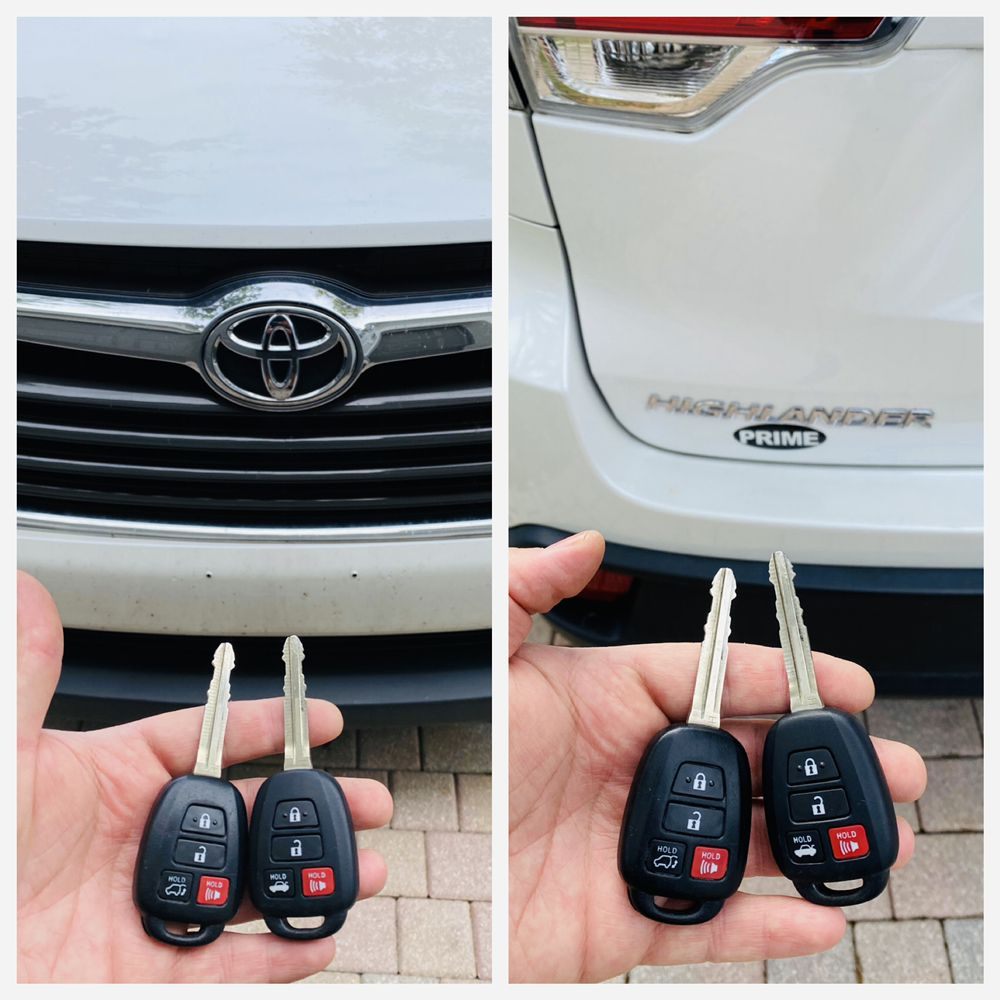
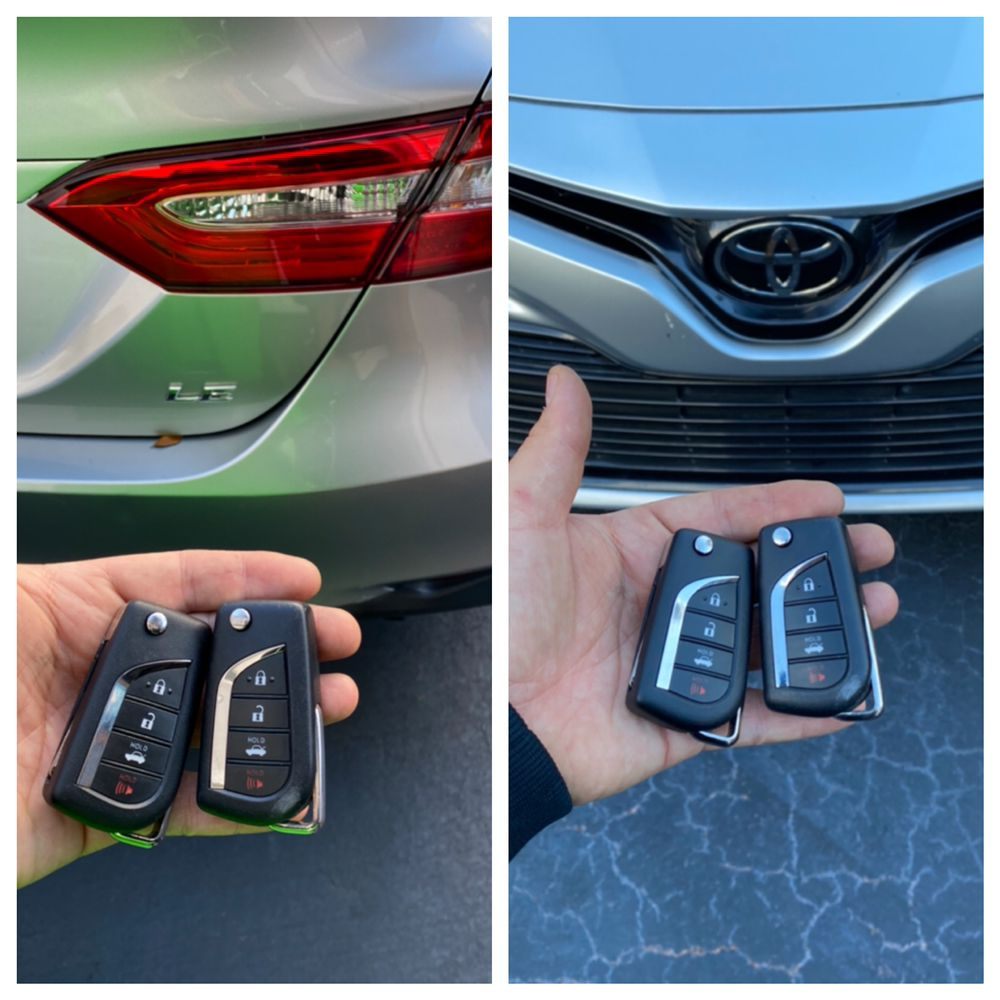
Many Toyotas offered a remote head key, where the blade, the chip and the lock and unlock buttons are all in one piece. Some use a flip style, where the blade folds into the fob. These are common on Camry, Corolla, RAV4, Highlander and Venza trims that kept a keyed ignition.
The buttons are typically lock, unlock and panic, sometimes with a trunk or hatch button. The remote side and the chip side are programmed separately, so a replacement may need both done. When the rubber on these fobs wears out, people often assume the whole key is dead, but a new shell or a battery change can be enough. We check before replacing anything. Our guides to remote head keys and flip keys explain the difference.
Push Button Smart Keys
A smart key lets you leave the fob in a pocket or purse. The car senses it nearby, unlocks when you touch the handle and starts when you press the brake and the start button. Most recent Camry, Corolla, RAV4, Highlander, Tundra, Sienna, Prius and Sequoia vehicles use this style, and the newest redesigns use it almost everywhere.
A smart key and a remote head key are not interchangeable. The first thing we check is whether your car has a start button. If it does, you need a proximity smart key. If it has a keyed ignition, you need a chip key or remote head key. Ordering the wrong one is one of the most common mistakes we see from people who buy a key online. Inside each smart key is a hidden emergency blade, and we cover the larger topic on our push to start smart keys page.
Call Pro Locksmith at (954) 406-8266. Tell us the year, make and model and where the car is parked, and we will confirm what your vehicle needs before any work starts.
Mixed Key Types Inside One Model
This is where Toyota owners get confused. A base trim with a keyed ignition and a higher trim with push button start can share the same model name and the same year. The Highlander is a good example: many base versions kept a remote head key while higher trims moved to a smart key. The RAV4, Camry and Tacoma follow similar patterns.
The Tacoma, Tundra, 4Runner, Sienna and Sequoia show another pattern, where a long run of years uses a chip key on keyed trims while smart keys appear on some higher trims. The newest generations of the Tacoma, Tundra, Sienna and Sequoia moved to smart keys. Because the data for many of these is trim dependent, we say most and many instead of promising a fit, and we confirm the exact key at your car.
Model Families We Work On
Our model list on this page shows the Toyota nameplates we service. A few notes help explain what we usually find:
Camry and Corolla
Both started with chip keys, moved through a remote head or flip stage and now use smart keys on push button trims. The Corolla changed earlier than the Camry in some areas, which is a good example of why year alone does not tell the story. Base trims with a keyed ignition may still use a flip or remote head key.
RAV4, Highlander, Venza
These SUVs run from chip keys to remote head keys to smart keys. In many years the answer depends on trim, with higher trims getting the smart key first. The later hybrid models are smart key vehicles.
Tacoma, Tundra, 4Runner
Trucks and truck based SUVs stayed with chip keys on keyed trims for a long time, with smart keys on push button versions. We often meet these in fleet and work use, where keys get lost on job sites.
Prius, Sienna, Avalon, Sequoia, Land Cruiser
The Prius used push button start earlier than most Toyotas. The Sienna, Avalon and Sequoia mix key types by trim and then move to smart keys in later generations. The Land Cruiser mostly follows the smart key path on later models.
Yaris and Matrix
These smaller cars used chip keys. The last Yaris was built by another manufacturer and its key differs from earlier ones, so we confirm it by VIN before ordering anything.
All Keys Lost Versus Adding a Spare
Making a spare while you still have a working key is the easier and more affordable path, and we strongly encourage it. The car already knows one key, so we can add another to its memory without erasing anything. If you are down to one key, that is the right moment to call.
All keys lost is a different job. With no working key to copy from, the car’s security system must be reset and new keys introduced from scratch. On older chip key vehicles this is routine work for us. On newer smart key Toyotas it takes specialized equipment and more time, because the car builds in a deliberate delay during the reset. We explain the process on our all keys lost page and our page about replacing lost car keys.
Bring Every Key You Own
On newer Toyota smart key systems, resetting the immobilizer can erase every key that is not present at that moment. That means if you have a key at home in a drawer and we do not know about it, it may stop working for good after the job. A key that is erased this way cannot be brought back later.
So the rule is simple. Gather every key and fob you own before we start, including the old spare, the valet key and the one your teenager keeps in a backpack. If a specific key was stolen or lost and you want it shut out of the car, tell us. In many cases we can remove only the missing keys while keeping the ones you have, which is better than a full reset.
Toyota and Lexus Share a Lot
Toyota and Lexus use closely related security systems, and the procedures the manufacturer publishes for one are almost mirror images of the other. If you own both, you will see similar behavior. A Lexus tends to move to proximity keys earlier and more completely, while Toyota keeps more mixed key types across its range.
The practical effect is that the lessons above apply to both brands. Identify the key by looking at the car and the key, not by assuming. Match the board and the chip, not just the outside shape. If your family has a Toyota and a Lexus, our team can handle both in one visit.
What We Need From You
For your protection and ours, we ask for proof that the car is yours. A registration or title together with a photo ID that matches is the usual combination. For a rental, a fleet vehicle or a car owned by a company, we ask for paperwork showing you are authorized to have a key made.
We also need to identify the vehicle. The VIN, which you can read through the windshield at the bottom corner on the driver side, tells us the exact model, trim and equipment. A photo of any key you still have, even a damaged one, helps us a lot. If you can tell us whether the car has a start button, that speeds up the plan before we arrive.
- Photo ID that matches the ownership paperwork
- Registration, title or authorization documents
- The VIN from the dash or the door jamb
- Every key and fob you still have
- A note on whether the car has a start button
How a Visit Works
We come to you. Home, office, a parking garage in Hollywood, a shopping center in Pembroke Pines or the side of a road in Plantation. We start by checking your paperwork and the vehicle, then confirm the key type by VIN and by looking at the car. Next we cut the blade if the key has one, and then program the chip and the remote functions.
Before we leave, we test everything. That includes the doors, the trunk button if there is one, the start function and the emergency blade where it applies. If you called about a car lockout first, our [[car-lockout]] team can get you back in so the rest of the work can go ahead. If a key has snapped off in the lock, we handle that too.
Fob Care, Batteries and a Dead Fob
Different Toyota fobs use different small batteries, so we do not give one number for all of them. Open the case, read the cell and replace it with the same type, or ask us. When the car starts reading the key only at close range or the buttons need a second press, the battery is the first suspect.
If a smart key goes dead, you are not stuck. Most have a small emergency blade that slides out of the fob and opens the driver door. To start the car, many models allow you to hold the fob against the start button while pressing the brake, because the chip inside works without battery power. Check your owner’s manual for the exact spot on your model. Keep a spare in a different place from your main set, and avoid leaving a fob in direct sun.
When a Dealer Visit Might Be Needed
Most Toyota work can be done at your location by a locksmith with the right tools. There are edge cases. A very new model, an unusual import or a key that refuses to register can mean a visit to a dealer. Some used smart keys are locked to their previous car and cannot be reused, which matters if you bought a key online.
We will tell you plainly if your car is one of these. The rule is that we would rather say so on the phone than have you wait and find out at your driveway. For anything involving newer vehicles, call before planning, and we will explain what applies. See our [[key-programming]] page for more on how we handle programming across makes.
Common questions
How do I know if my Toyota needs a smart key or a regular key?
Look for a start button. If your Toyota starts with a push button and you can keep the fob in a pocket, it uses a proximity smart key. If you put a key into the ignition and turn it, it uses a chip key or remote head key. The two are not interchangeable, so check before buying a key. We also confirm by VIN.
I lost my only Toyota key. Can you make a new one at my location?
In most cases yes. We come to the car, verify ownership, identify the key by VIN and cut and program a replacement. Newer smart key models need more equipment and time, and some very new vehicles need dealer-level steps. We will tell you which applies when you call, based on your model and year. If your car has a push button start, tell us when you call so we can bring the right equipment.
Will programming a new key erase my other keys?
Adding a spare while you have a working key normally leaves your other keys alone. An all keys lost reset on newer smart key systems can erase every key that is not present. That is why we ask you to bring every key you own to the job, including old spares. Adding a spare is a much simpler job, so make one before the last key goes missing.
Why did my key fit the lock but the Toyota would not start?
The blade can be cut correctly while the chip inside the head has never been registered with the car. The ignition may turn, yet the engine stays off because the immobilizer does not recognize the key. Programming the chip fixes it. A wrong chip type for your model gives the same result. The same applies to a key that works the doors but never starts the car, which is a common situation after a cheap online purchase.
Is the key the same for every year of a Toyota model?
No. Toyota changed key systems model by model, and many models mixed key types in the same year by trim. A Corolla changed earlier than a Camry, for example. That is why we confirm your key by VIN and by checking the car, and not by model year alone. We always check the VIN first, and that takes only a moment on the phone or at the car.
My Toyota smart key stopped working. Does it need replacing?
Often it only needs a fresh battery. Weak batteries cause short range and button delays. If a new battery does not help, the fob may be damaged, or the car may have a separate problem. Bring a spare key if you have one, since testing it helps us find the cause. If it is a push button car, remember the emergency blade and the start button trick in your manual can get you moving meanwhile.
Can you make a Toyota key if the car is in a parking garage?
Yes. We are mobile and work wherever the car is, as long as we can get safe access and verify ownership. Garages, driveways, office lots and roadsides across Broward, Miami-Dade and Palm Beach County are all normal for us. Tell us the level and spot when you call. It also helps if you tell us the make, model and approximate year, plus whether you still have any key at all.
Should I buy a Toyota key online and bring it to you?
Be careful. Many online keys are the wrong type, a different board or a used key locked to another car. Call us first with your VIN so we can tell you what your car needs. Buying the wrong key wastes time, and some cannot be programmed at all. We are always glad to look at a key you already own and tell you honestly whether it is the right one.
Call Pro Locksmith at (954) 406-8266. Tell us the year, make and model and where the car is parked, and we will confirm what your vehicle needs before any work starts.