

What Actually Makes a Key Replacement Go Quickly
People searching for the fastest car key replacement usually picture a technician who drives faster. In practice, the biggest time savings come before anyone leaves the shop. A job moves smoothly when the technician knows exactly what key the car uses, has that blank and the right programming equipment on the truck, and can reach the vehicle without trouble when they arrive. Most delays come from missing information, the wrong part, or a car that turns out to be somewhere the truck cannot get to.
You control more of that than you might think. The more precisely you describe the car and the situation on the first call, the more likely the job is finished in a single trip.
Information That Saves the Most Time
- Year, make, model and trim. Two cars with the same name can use completely different keys depending on the year or the trim level.
- How you start the car. Do you insert a key and turn it, or press a start button with the fob somewhere in the car? This tells us whether you need a blade key, a remote key, or a proximity fob.
- The vehicle identification number. Visible through the windshield on the driver’s side. It lets us confirm the correct key before we arrive.
- Whether any working key still exists. Adding a key when you still have one is usually simpler than creating one when every key is gone.
- Exactly where the car is. Street address, the level and section of a parking garage, or the name of the lot.
If you have a photo of the old key or even an old key that broke, send or show it. It removes guesswork about which blank and which remote shell to bring.
What “All Keys Lost” Really Involves
When every key is gone, the locksmith has to create a key from nothing. The mechanical cut can be determined in a few ways. On many vehicles, the key code can be looked up through authorized industry databases using the vehicle identification number and proof of ownership. On others, the technician decodes the door lock or ignition to read the cut depths directly. Once the blade is cut, the new key or fob is programmed to the vehicle’s immobilizer so the engine will start.
Some vehicles build in deliberate waiting periods during programming. The car’s security system makes the technician wait through one or more timed cycles before it will accept a new key when none of the old ones are present. This is a theft deterrent built in by the manufacturer, and there is no legitimate way to skip it. If your car is one of these, we will tell you in advance so the wait is not a surprise.
Why Some Jobs Are Simply Longer
Being honest about timing is more useful than promising speed. A basic mechanical key for an older car is a short job. A proximity fob for a newer vehicle, programmed with all keys lost, takes longer because of the steps involved. Vehicles whose programming requires online authorization from the manufacturer can depend on that system being available. And a few newer models can only have keys added through the dealer. When you call, we will tell you where your car falls on that range, and if a dealer is the only option, we will say so rather than waste your time.
Where You Are Stuck Matters
Fort Lauderdale has some locations that come with their own logistics. Knowing them in advance helps.
Parking garages downtown and along Las Olas. Many garages have low clearance that a service van cannot pass under. If your car is on an upper level of a low garage, the technician may need to carry equipment up from street level. Tell us the garage name and level so we can plan.
The airport. If you lose your key while traveling, and your car is in long term parking at Fort Lauderdale Hollywood International Airport, access rules for service vehicles in airport garages can add steps. Let us know which garage or lot, and we will work out the best way to reach the car.
Port Everglades. Cruise passengers sometimes return to find a key lost on the ship or during the trip. Cruise parking facilities have their own access procedures, so tell us where the vehicle is parked and we will coordinate from there.
Beach parking along A1A. Keys lost in the sand or in the water are common. Metered lots and street parking are generally easy to reach, but tell us the nearest cross street or landmark so the technician finds the car without circling.
Gated communities and condo garages. Leave the technician’s name with the gate or give us the gate code, and let the front desk know a service vehicle is expected.
Rental Cars, Leased Cars and Company Vehicles
Rental vehicles belong to the rental company, and most rental agreements require you to contact the company if a key is lost. Many rental companies have their own roadside process and may not authorize an outside locksmith to program a key to their vehicle. Call the rental company first. Leased vehicles are different: the lease holder is usually authorized to have keys made, and we will ask to see the lease or registration. Company vehicles typically need authorization from the business that owns them, so have a manager’s contact information ready.
Keys That Went for a Swim
Boating and beach days are a big part of life in Fort Lauderdale, and so are fobs that ended up in salt water. If your key got wet, take it out of the water right away, remove the battery if you can, open the case if it separates easily, rinse the board gently with fresh water, and let it dry completely before trying it. Fresh water dunks often survive. Salt water frequently corrodes the circuit board even after it dries. If the remote buttons stop working but the car still starts, the transponder chip may be fine while the remote section has failed. We can often replace the remote portion or program a new fob and erase the damaged one.
Dealer Versus Mobile Locksmith
A dealer can make a key for any vehicle it sells, but it usually requires the car to be at the service department. If every key is lost, that means towing. Dealers may also need to order a key cut from a code, which can take time. A mobile locksmith comes to the car and cuts and programs on the spot for the majority of vehicles. Neither option is right for every situation. For most Fort Lauderdale drivers with a common vehicle, mobile service is the more practical path. For some recent luxury or specialty models, the dealer may be required. We will tell you which applies to your car.
Proximity Fobs Versus Remote Keys
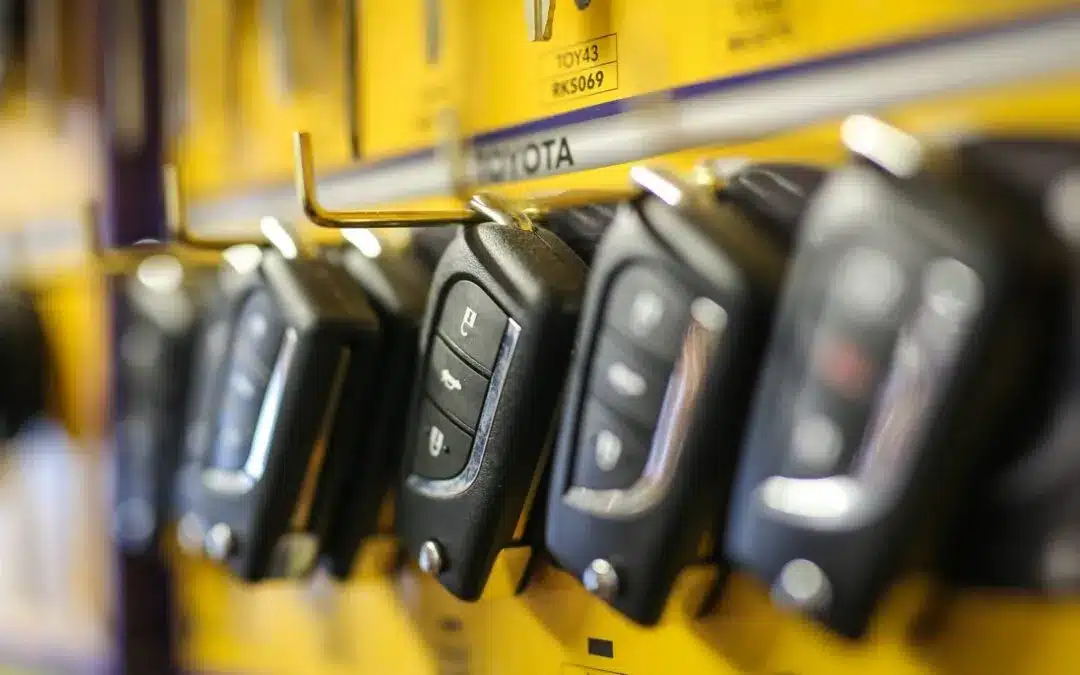
Push to start vehicles use a proximity fob that the car detects when it is inside the cabin. These fobs almost always contain a hidden emergency blade for the door lock, released by a small button or slide on the fob. Remote head keys and flip keys combine the blade and the remote in one unit. Proximity fobs typically involve more programming steps than a remote key, and their batteries tend to run down faster because the fob is always communicating. If your push to start car suddenly says “key not detected,” try holding the fob directly against the start button. Many vehicles can read a fob with a weak battery at that close range.
After the New Key Works
Once you are back on the road, a few steps protect you from going through this again:
- Have a second key made while you still have a working one. It is far simpler than starting from zero.
- If the lost key could be found by someone who also knows where the car is parked, ask to have the old key erased from the vehicle’s memory.
- Keep the spare at home in a consistent place, not in the glove box.
- Replace fob batteries before they are completely dead, especially on proximity fobs.
- Replace a key blade that is cracked or worn thin before it breaks off in the lock or ignition.
Keys for Older Vehicles
Not every car on Fort Lauderdale roads is new. Plenty of drivers keep an older truck, a classic, or a second car that predates transponder chips. These keys are purely mechanical and are usually the simplest to replace. If the ignition is worn, though, a new key cut to factory depths may feel tight or refuse to turn in a cylinder whose wafers have worn down over the years. In that case the technician may cut the key to match the worn lock, or recommend servicing the ignition so both old and new keys work reliably.
Proof of Ownership, Explained
Every legitimate locksmith will ask you to prove the car is yours before making a key. That usually means a government issued photo ID and a registration or title with a matching name. If the car is registered to a spouse or family member, bring documentation that shows the connection or have the owner available by phone. If the paperwork is inside the locked car, we open the vehicle first and check it there. This is not red tape. It is what keeps someone else from getting a key to your car.
Serving Fort Lauderdale and Surrounding Areas
We handle car key replacement throughout Fort Lauderdale, including Victoria Park, Coral Ridge, Harbor Beach, Rio Vista, Wilton Manors, Oakland Park and Lauderdale-by-the-Sea, and across the rest of Broward County, north to Boca Raton and Delray Beach, and south to Aventura, North Miami, Coral Gables and Coconut Grove. Call (954) 406-8266 with your vehicle details and location, and we will tell you what your key replacement involves before anyone heads out.