

A push to start smart key lets you unlock the doors and start the engine without ever taking the fob out of your pocket. When one is lost, cracked or dead, Pro Locksmith comes to your car anywhere in Broward, Miami-Dade and Palm Beach County and gets you driving again.
What a push to start smart key actually is
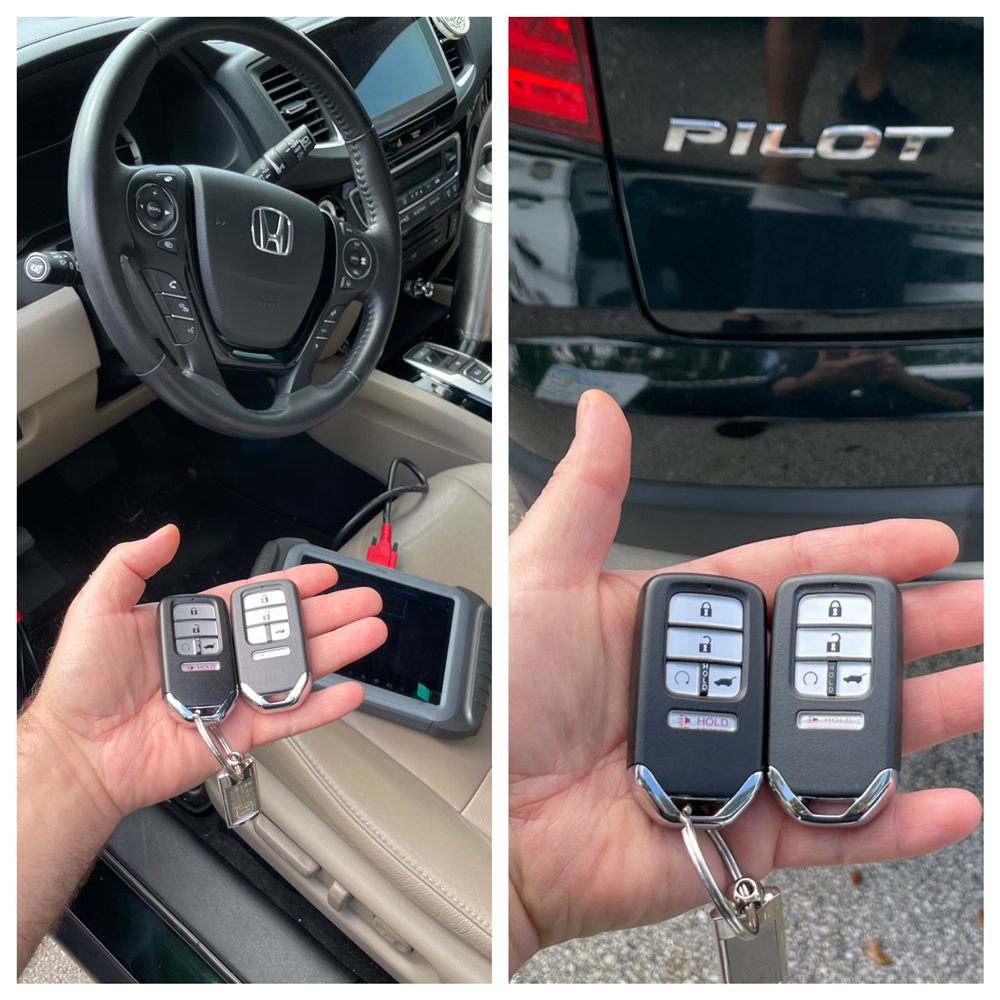
A push to start smart key, also called a proximity key, an intelligent key or a keyless go fob, is a small electronic transmitter that talks to your car without you pressing anything. Walk up with it in your pocket and the doors unlock. Sit down, press the brake, press the start button, and the engine runs. The metal key you grew up with is gone from the daily routine.
Inside the fob there is a battery, a radio, a small processor and a chip that holds a secret code. That code is paired to your car at the factory or by a locksmith. The car will only start for a fob whose code it has been taught to accept. A fob from another car of the same model looks identical but will do nothing, which is why a smart key can never simply be bought, dropped in a pocket and used.
Most smart keys also hide a short emergency blade inside the fob. That blade opens the driver door if the fob battery dies. It does not start a push button car by itself, and we will explain what does in a later section.
How the car knows the key is nearby
Your car has several small antennas, usually in the door handles, the trunk or tailgate, and the cabin. When you touch a handle or press the start button, the car sends out a short low power signal asking whether a key is close. The fob answers with an encrypted reply. If the answer matches what the car expects, the car unlocks or allows the engine to start.
The reply is not a fixed number. Modern systems change the code every time, so someone recording the signal cannot simply replay it. That is the same idea behind the immobilizer in an older chipped key, only done wirelessly and with stronger math. If you want the background on the older style, our page on transponder keys explains how a chip and an immobilizer work together.
Because the car checks for the fob inside the cabin before it lets the engine start, you will sometimes see a message such as key not detected even though the fob is in your hand. That usually points to a weak battery, a damaged fob, interference from another device in the same pocket or a fault in the car, not a problem with the start button itself.
Which makes use push to start smart keys
Almost every make we service now offers a smart key on at least some trims. Toyota and Lexus brought push button start to the market in the mid 2000s, starting with hybrids and upper trims, and spread it to most trims by the late 2010s. Honda and Acura moved to smart keys on most models from about 2013 on. Nissan calls its version the Intelligent Key, and Infiniti uses the same system, with most Nissan models listed as Intelligent Key only by about 2017.
On the American side, Ford uses Intelligent Access and Lincoln shares it. Chevrolet, GMC, Buick and Cadillac use proximity fobs on most models from the late 2010s, with flip keys remaining on some base trims. Chrysler, Dodge, Jeep and Ram moved to proximity push button fobs after their bladeless Fobik style, and the Wrangler, Durango, Pacifica, Grand Cherokee and the redesigned Ram 1500 all fall in that group.
Among the imports, Hyundai and Kia offer smart keys on higher trims, Mazda calls it the Advanced Key, Subaru moved most models to smart keys on upper trims in the middle of the last decade, and Mitsubishi began with the Outlander. BMW, Mini, Mercedes-Benz, Audi, Volkswagen, Volvo and Land Rover all use proximity keys on many models. Check our car keys by make, model and year hub to see how your brand fits.
Same model, different key
Many cars mix key types in the same model year. A base trim may have a keyed ignition with a flip key while the next trim up has a start button and a smart key. Audi is a well known case, where the Advanced Key was an option for years, so two cars of the same year can have different keys. This is why we confirm by VIN and by looking at the car before we order or cut anything.
What owners in South Florida usually run into
Our climate is hard on small electronics. Heat inside a parked car in July can soften the glue that holds a fob together, and a fob left on a dashboard or in a cupholder bakes far longer than one that lives in a pocket. Humidity gets into cracked cases, and salt air near the beach can corrode the battery contacts and the small circuit board. A fob that has been dropped near the water, or worn by a swimmer at the beach, often fails for exactly that reason.
Rental and fleet cars are another pattern. Rental companies buy cars with two fobs, and one of them tends to disappear within a year or two. If you have bought a former rental or fleet vehicle, ask for every key it came with, because the missing one may still be out there.
Used car purchases are the third big one. Dealers and private sellers in South Florida often hand over a single fob. Seasonal residents leave cars sitting for months with the battery dying, and when they come back the car does not respond to the fob at all. We see all of these situations regularly, and the right answer is different for each.

Smart key, remote head key and flip key compared
A remote head key is a regular key blade with the lock and unlock buttons built into the plastic head. It goes in a keyhole and turns. A flip key folds the blade into the fob like a pocketknife, and it still goes into a keyhole. A push to start smart key has no required keyhole use at all. These are three different families, and they are not interchangeable even when two of them look similar in a photo.
If your car has a start button and a smart key, you cannot use a remote head or flip key in its place, and the reverse is true as well. Pages for remote head keys and flip keys cover those styles in detail.
A simple way to tell what you have is to look at the dashboard. A key slot or a round ignition cylinder means a key that turns. A start button with no slot beside it means a proximity key. A start button plus a small slot near the steering column or console means a fob that docks in that slot for starting, which is common on older Mercedes-Benz, BMW and Mini models. We can tell you the family from a photo or from the VIN and then confirm at the car.
The emergency blade and dead battery start
Every smart key is built so that a dead fob battery does not strand you. The first part is the emergency blade. Look on the fob for a small release latch or button. Slide it and a short metal key comes out. Many cars hide the keyhole under a small cover on the driver door handle, so you may need to pry that cover gently with the blade tip. This opens the door only.
The second part is starting the engine. The method depends on the maker. Some cars want you to hold the fob against the start button. Others have a small pocket in the console, glovebox or cupholder where you place the fob so the car can read it at very short range. GM, for example, uses a pocket rather than a hold to button method. Your owner manual shows the spot. Mitsubishi and several others have a backup location in the glovebox.
If the car starts that way, the key is fine and only the battery needs replacing. If it does not, the fob may have failed or the car may not recognise it, and that is when you call us.
Call Pro Locksmith at (954) 406-8266. Tell us the year, make and model and where the car is parked, and we will confirm what your vehicle needs before any work starts.
Replacing a smart key when you still have one
When you still have a working fob, replacing the second one is the simpler job. We read the car, cut the emergency blade if your car needs one, and add a new fob to the system. Depending on the make, the car may keep your existing fob in memory or may need all fobs programmed at once. We explain that in plain words before we begin.
For some cars the on board method is possible, and for others a diagnostic tool is needed. Domestic makes like Chrysler have long had a method that uses two working keys, while many import brands need us to connect to the car and register the new key electronically. Our key programming page walks through how this works.
The smartest thing a car owner can do is not wait until the last key is lost. Making a spare while you still have a working one is almost always less stressful and less work for the car than starting with nothing.
All keys lost on a push to start car
An all keys lost job means the car has no working key at all. On a smart key car that is a much bigger task than adding a spare, because there is nothing left to authorise the new fob. We have to talk to the car as the owner would from the dealer, using a diagnostic tool and the correct security access for your car.
The details differ a lot by brand. Some cars give up their security data after a short waiting period and then accept a new fob. Some need a code that must be read from the car’s control module, which can take more steps. Some current models need an online session with the manufacturer, and for those we explain upfront what the dealer-level requirements box on this page says.
Our page on lost all car keys replacement covers the whole process from the first call to a running car. If you are standing next to a car with no key at all, that page is the one to read.
The immobilizer ideas you should know about
Every smart key system includes an immobilizer, and a few ideas show up again and again. The first is the relearn. Many systems erase all existing keys at the moment the first new key is programmed, so every key you want to keep must be with us for the whole visit. General Motors vehicles are a clear example, where the older relearn procedure wipes the car’s memory of previous keys.
The second is the security delay. On some cars the system makes you wait before it accepts programming. In the older Ford and Chrysler procedures that wait could run about ten minutes on certain models, and in some Nissan systems it ran longer. We schedule time for it so the job is not rushed.
The third is the PIN or security code. Some brands, including Nissan and Chrysler, use a code stored in a control module that has to be read before a key can be added. The fourth is server registration. On newer Mercedes-Benz models, a genuinely new key is registered through the manufacturer’s server. On newer Fords, the older security delay was replaced by manufacturer credentials, so those jobs are dealer level. On some recent Toyotas and Lexus models, resetting the immobilizer erases every key that is not present, so bring every key you own.
Why used fobs and online fobs cause trouble
It is tempting to buy a used fob from an online marketplace because it costs less. We understand why. The problem is that a used fob is usually already paired to another car. On some brands that pairing can be undone, and on many it cannot. A fob that has been locked to another vehicle is a paperweight to your car.
Cheap new fobs are not always right either. Frequencies, button layouts and internal electronics differ between versions, and a fob that looks identical may not communicate properly. Some Land Rover models are known for rejecting low quality fobs, and a failing fob battery or a weak keyless module can look just like a lost key.
If you already bought a fob online, keep it and show it to us before you go any further. We can tell you whether it is likely to work. If it will not, we will tell you plainly instead of letting you lose time and money on programming attempts that cannot succeed.
What we need from you
For any push to start key, we need two things: proof that the car is yours, and a way to identify exactly which car it is. For proof of ownership, a registration or title that matches your photo ID is the usual standard. For vehicle identification, the VIN on the dash by the windshield or on the driver door jamb is the key piece of information. We use it to confirm the exact key and fob type before we cut or program anything.
If you can, gather every key you own for the car, including any broken or old ones. Those help with identification and, as explained above, on some systems they must be present during programming. Tell us the trim if you know it, and send a photo of the dash if you are not sure whether the car has a slot or a button.
A locksmith who does not ask for ownership proof is a locksmith you should not trust with your car. We ask every time, for every vehicle, because it protects you.
How a visit works
You call, tell us the make, model, year and where the car is, and we confirm the details by VIN. We explain what your car will need and what kind of work is involved. Then a technician drives to you. Because we are a mobile service, your car stays right where it is, in a driveway, a parking garage, a workplace lot or at the side of the road.
At the car, we check ownership and the VIN again, test the existing key if there is one, and connect our equipment. If the emergency blade is needed, we cut it on the spot. We program the new fob, test it on the doors and on the start button, and test any other fobs you have. Then we hand them back and explain how to care for them.
We serve Fort Lauderdale, Hollywood, Pembroke Pines, Coral Springs, Plantation, Pompano Beach, Boca Raton, Miami, West Palm Beach and the towns between them. If you are not sure we cover your area, just ask.
Fob and battery maintenance
Most smart key fobs run on a small coin battery. The type varies by make, and some newer models use a different size from older ones, so check the back of the case or the owner manual. Replace the battery about every couple of years or at the first sign of a shorter range, a delay in unlocking or a warning message on the dash. A weak battery rarely fails all at once, and catching it early prevents most of the lockouts we are called to.
Keep the fob away from heat and water. Do not leave it in a hot car, on the dash or in a pocket while swimming. If it does get wet, open the case, dry it thoroughly and have the contacts looked at before the corrosion spreads. A silicone case helps against drops, though thick cases can reduce range slightly.
Finally, many owners in South Florida find that a fob stored in a pocket next to a phone and another fob sometimes behaves oddly. Keeping the fob on its own often fixes odd range problems.
When a dealer visit may be needed
Some current models are locked down so tightly that only the manufacturer can supply or program a new key. Newer Fords, Mercedes-Benz models with the latest security, recent Land Rover models and some late-model GM vehicles tied to the maker’s online system are good examples. We do not guess and we do not take work we cannot finish.
The dealer-level requirements box on this page lists what we can and cannot do under current limits. When your car falls into a dealer-level group, we will tell you plainly, and we can help in other ways, such as extracting a broken blade or arranging a lockout service for the visit.
If your car is a newer model and we find we can do the job, we do it. If not, you will know before we begin. Either way you will leave with a clear plan instead of a mystery.
Mistakes to avoid with a smart key
Do not keep both fobs in the same place. A bag, a coat pocket or a house hook holding every key is one theft or one lost bag away from an all keys lost call. Do not ignore a low battery warning. Do not try to reprogram the key yourself using steps from a video unless you fully understand the car, because on some systems a failed attempt can lock out further programming for a period.
Do not buy a used fob and assume it will work. Do not let anyone cut a blade and tell you the car is done, because a blade on a smart key is only the emergency part. And never hand a stranger your registration without knowing who they are and how they will use it.
Two other points. If you see a dash message about a key not being detected, replace the battery first, and if that does not help, call us before you try anything else. And if you are buying a used car, ask the seller how many working fobs exist and test each one before you pay.
Common questions
Can you make a push to start key if I lost every key?
In most cases yes. We connect to the car, register a new fob and cut the emergency blade if needed. Some newer models need dealer-level or online manufacturer access, and the dealer-level box on this page lists those limits. We confirm your VIN and ownership first, and we tell you before starting whether your car falls into a dealer-only group.
Is a smart key the same as a key fob?
Not exactly. A key fob is any small remote, including one attached to a regular key. A smart key is a proximity fob that lets you unlock and start the car without inserting anything. Some cars use a fob that docks in a dash slot, which is a different style again. We identify the right family by VIN and by looking at the dash.
My smart key stopped working. Is the key lost or just the battery?
Often it is only the battery. Try the emergency blade for the door and the backup start spot in your manual, such as a console pocket or holding the fob against the start button. If the car starts that way, replace the battery. If the car still refuses, the fob or the car may have a fault, and we can test both.
Can I buy a fob online and have you program it?
Sometimes, but we ask you to show it to us first. Many used fobs are locked to another car and cannot be reused, and cheap new fobs may use the wrong electronics. If your fob is the right type for your car, we can usually program it. If not, we will say so plainly before any work starts.
Why do you need to see all my keys during programming?
On many cars, programming a new key clears the older keys from memory, and anything that is not present may be locked out for good. Some Toyota and Lexus systems work this way, and so do some General Motors and Honda jobs. Bringing every key you own protects you from losing a working spare.
Will a dealer be the only option for my newer car?
For some late model vehicles, yes. Newer Fords, the latest Mercedes-Benz systems and some recent GM and Land Rover models need manufacturer-level access. Check the dealer-level box on this page for the limits we work under. If your car is on the list, we will tell you before you spend anything on a visit.
How long does a smart key last?
The electronics often last many years, but the battery needs replacing every couple of years and the case can crack from heat and drops. In South Florida, heat and humidity shorten the life of fobs that sit on a dash or get wet. Replacing the battery on time and avoiding heat extends the life.
Do you come to my location?
Yes. We are a mobile service based in Fort Lauderdale, and we come to your car, home or business in Broward, Miami-Dade and Palm Beach County. Your car does not need to be towed. Give us the make, model, year and the exact location when you call, and have your ID and registration ready.
Call Pro Locksmith at (954) 406-8266. Tell us the year, make and model and where the car is parked, and we will confirm what your vehicle needs before any work starts.