

A transponder key looks like an ordinary car key, but a tiny chip inside it must match the car before the engine will run. Pro Locksmith cuts and programs these keys at your car across Broward, Miami-Dade and Palm Beach County, including when every key is lost.
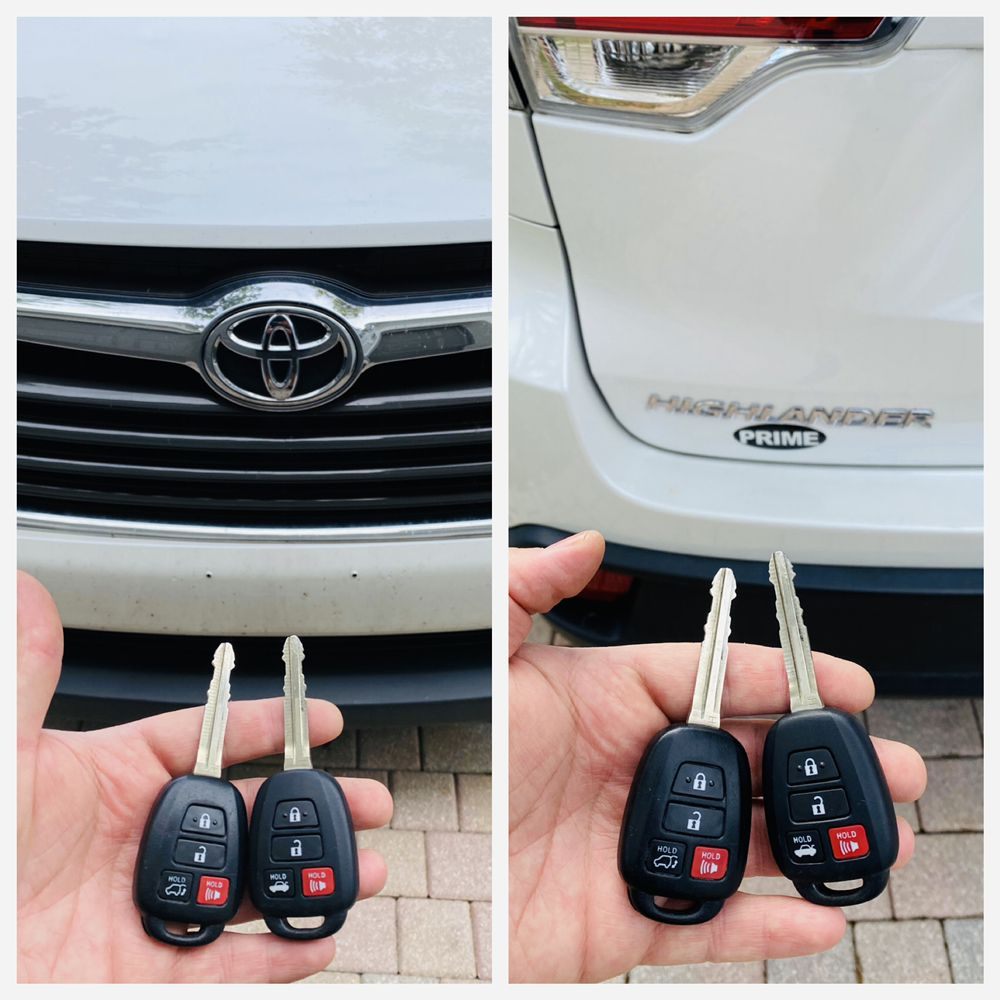
Why a cut key alone will not start the car
Almost every driver has heard of a friend who got a copy of a car key at a hardware store, found that it turned the ignition and then watched the engine refuse to start. That is a transponder key problem. The blade did its job and the lock turned, but the car never heard from the chip.
A transponder key is any key with a small electronic chip, usually hidden inside the plastic head, that talks to the car. The chip has a code, and the car’s immobilizer module has a list of codes it will accept. When you turn the key, the car sends out a short radio burst that powers the chip, the chip answers, and the car decides whether to let the engine run. If the answer is wrong or missing, the starter may crank but the fuel or ignition is cut off.
This is why a hardware store copy usually fails and why a professional job has two steps: cutting the metal to match the lock and programming the chip to match the car. Both parts must be right.
How the chip and the car talk to each other
Around the ignition lock there is a small antenna ring. When you insert the key, that ring gives the chip a burst of radio energy, much like how a contactless payment card works. The chip does not need a battery for this. It wakes up, sends its code, and goes quiet again.
The earliest systems used a fixed code, which was a big improvement over a plain key but could in theory be copied. Later systems use a challenge and response. The car sends a random question, the chip does some math with a secret value and sends back an answer. A thief cannot just record and replay it because the question is different each time.
The details differ between makers, but the idea is the same everywhere. If you want to compare it with the wireless version used on newer cars, our page on push to start smart keys explains how proximity keys continue this idea without a keyhole.
A short history of chipped keys
Before immobilizers, a car key was a mechanical thing and nothing else. In the 1980s and 1990s, General Motors used a system known as VATS, which put a small resistor pellet in the blade. The car measured the resistance and refused to run if it was wrong. Some GM vehicles then used a different system called Passlock, where a sensor in the steering column handles the check and the key itself has no chip at all.
Ford introduced its Passive Anti-Theft System around the 1999 model year on most models, and Chrysler brought in its Sentry Key system for the 1998 model year. Nissan, Honda, Toyota and others followed through the late 1990s and early 2000s. By the middle of the 2000s a car without an immobilizer was becoming unusual.
The next step was the smart key, which replaced the ignition keyhole with a button for many cars. Even so, plenty of vehicles on South Florida roads still use a chipped metal key, and these are the cars we program most often.
Which makes use transponder keys
Chipped keys are everywhere. Toyota used transponder keys on most models by the early 2000s, and Corolla, RAV4, Highlander, Tacoma, Tundra and Sienna have all had them. Lexus models from the early 2000s, like the ES, IS, GS and RX, began with the same technology. Honda and Acura fitted them on the Civic, Accord, CR-V, Pilot, Odyssey and the MDX, TL and RSX in the 2000s.
Nissan and Infiniti used the NATS system through the 2000s, and models such as the Altima, Sentra, Maxima, Frontier and Pathfinder had them. Ford and Lincoln used them on the F-150, Explorer, Escape, Focus, Mustang, Expedition, Town Car and Navigator. Chrysler, Dodge, Jeep and Ram used the Sentry Key system on the Wrangler, Grand Cherokee, Durango, Caravan and Ram pickups.
General Motors used them on the Silverado, Malibu, Equinox, Impala and others from the early to middle 2000s. Hyundai and Kia fitted them to the Elantra, Sonata, Santa Fe, Optima, Sorento and Sportage. Mazda, Mitsubishi, Subaru, Volkswagen, Audi, BMW, Mini, Volvo and Mercedes-Benz all have chipped keys on many models. Start from the car keys hub if you want your make’s details.
A note on confidence
Key types often vary by trim, and the year a make changed from one style to another is not the same for every model. When we say most or many, that is because we confirm the exact key by VIN and by looking at the car before cutting or programming, and we encourage you to do the same with anyone you hire.
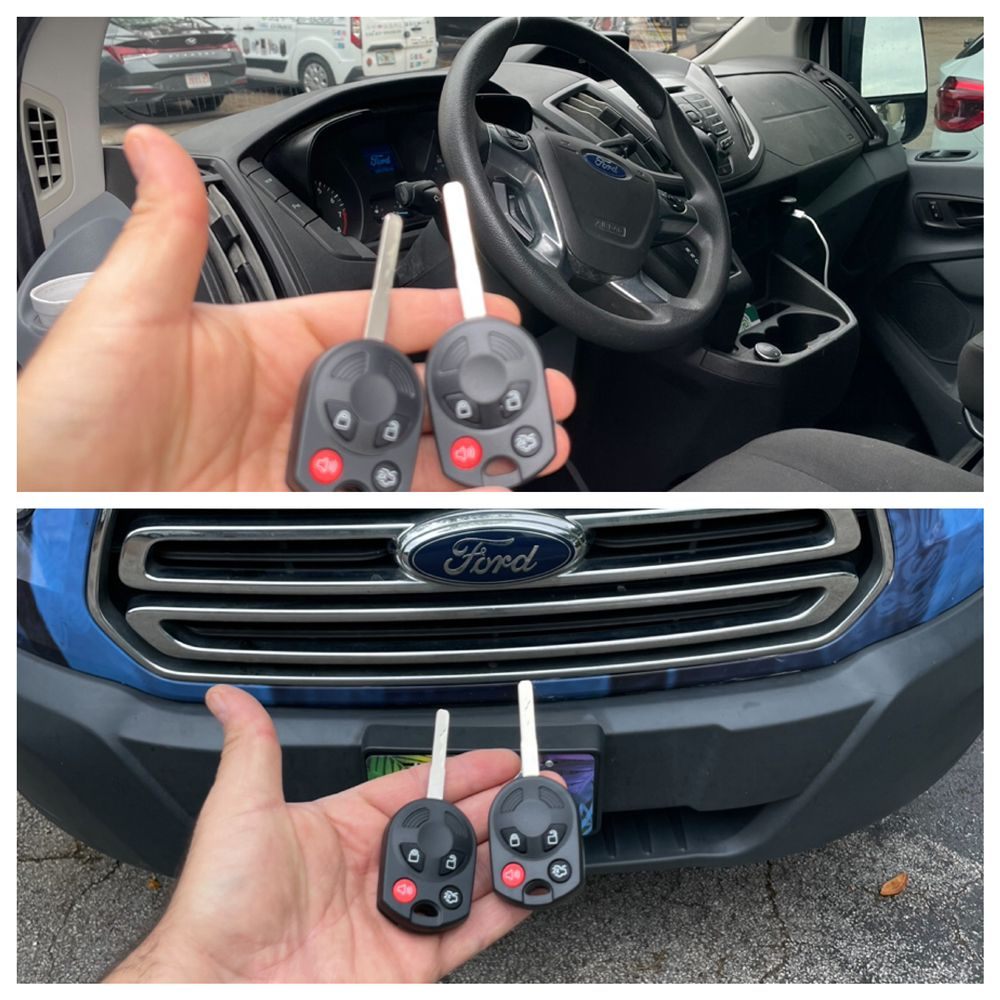
Transponder keys we see most in South Florida
Because Florida has so many older cars that are still running well, chipped keys are a large part of our work. Toyota and Honda sedans from the 2000s are very common, along with Nissan Altimas and Sentras, Ford trucks and Explorers, Chevrolet Silverados and Malibus, and Hyundai and Kia compacts. Many of these were bought used, sometimes with only one key.
We also see them on older Jeep Wranglers that live near the beaches, where salt and sand are hard on a key ring, and on work vans and trucks that employees share. Fleet vehicles often have a single key hanging on a board until someone loses it.
Seasonal residents bring a different pattern. A car that sat unused for months can have a flat battery, and when the battery is replaced the owner is sometimes unsure whether the key or the car is at fault. A simple test with our equipment answers that question.
Transponder key versus remote head key versus flip key
Three terms get mixed up. A transponder key is the family name for any key with an immobilizer chip. A remote head key is a transponder key with lock and unlock buttons built into the head. A flip key is a transponder key whose blade folds away into the fob. Both are covered on our pages about remote head keys and flip keys.
In practical terms, the immobilizer chip is always the critical part, and the buttons are an extra. Some cars have a plain chipped key and a separate remote fob. Others combine both. When we program, we do the chip first, since that is what lets the car start, and the remote function second.
Some customers are surprised to learn their key has no buttons at all and yet has a chip. That is common on many cars from the 2000s and perfectly normal.
Call Pro Locksmith at (954) 406-8266. Tell us the year, make and model and where the car is parked, and we will confirm what your vehicle needs before any work starts.
Cars that look chipped but are not
Not every old key has a chip, and not every car with a chip needs a chip key. Many older cars, from before the late 1990s, have only a mechanical key. Some General Motors vehicles of the late 1990s and early 2000s use Passlock, where the lock cylinder talks to the car and the key has no chip. On those a cut key alone may be all you need, though a relearn may be needed after a lock cylinder is replaced. See our page on standard keys without a chip if you suspect that is your car.
Some cars also have a chip in the key but only for part of their model run. Mazda put a plain key on some early models while others of the same time had chips. Subaru used a plain key on several models before the middle of the 2000s and added chips afterwards. The only reliable way to know is to check the VIN and the car.
If you are unsure, send us a photo of the key head and the ignition. A glance usually settles it.
Cutting the key correctly
Cutting is the part most people think of when they imagine a locksmith. We cut keys on site with a portable machine. For a standard edge cut key we follow the existing key or a code. For high security keys with a milled groove down the middle, we use a different machine, and our page on laser cut and high security keys explains that style.
Some blades look the same but are not. A good example from Ford is two blades that look almost identical but use different chips. A blade cut perfectly for the wrong chip will turn the ignition and will not start the car, and that mistake is one of the most common reasons people end up calling us after buying a key elsewhere.
Some Honda and Acura keys from the 2000s use a sidewinder cut that needs a special machine. We carry the machines needed for these. We cut by code or from the original key whenever we can, and if there is no original we can decode the lock itself.
Programming: how we teach the car a new key
Programming means telling the car’s immobilizer module to accept the chip in the new key. There are three main methods. The first is the on board method, where you perform a set of steps with keys already in the car. The second is a diagnostic tool method, where we connect to the car’s diagnostic port and use the tool to add the key. The third is a bench method, where a module is read on a bench to get a code before the key can be added.
Older Chrysler products, for example, let an owner with two working keys add a third without a tool. Many General Motors cars from the 2000s use a relearn in which the key is left on for a set period, three times, and the car then accepts it. Ford made owners with two keys able to program a third through a sequence of key turns, for many models.
What happens when you have fewer keys, or none, depends on the brand, which is where a professional’s equipment becomes essential. Our key programming page explains the difference between the methods in more detail.
Adding a spare versus all keys lost
Adding a spare when you have a working key is the easy case. We copy the cut, connect to the car, register the new chip and test it. The old key remains in memory on most cars, though some systems clear and relearn all keys at once, and we will tell you if yours does.
All keys lost is more involved. With nothing to prove the car is yours, the car needs to be told to forget its old keys and accept new ones. We cut a new key from the lock or by code, then use the correct security access for your vehicle. For some brands that means reading a code from a module, for others a waiting period, and for a few it means the dealer.
The main point we repeat to every customer is this: if you have even one working key, call us before it is lost too. A spare made from a working key is simpler to arrange, easier on the car and gentler on your plans for the day. The all keys lost route is explained step by step on our lost all car keys replacement page.
Immobilizer ideas that affect your job
Several features of immobilizers explain why one car takes a few minutes and another takes much longer. Nissan systems of the NATS family use a timed security access on some versions and a PIN code on later ones, and on some versions programming clears all existing keys. Chrysler systems let owners with two keys add a third without a PIN, while a one key or no key situation needs a PIN read from the control module.
General Motors cars from the PK3 era use a relearn that erases all earlier keys the moment the first new key is programmed, so every key you want to keep must be there. Honda all keys lost jobs also remove old keys from memory. On certain Toyota smart key systems, an immobilizer reset can permanently erase every key not present.
Mercedes-Benz splits into two generations. The older system, covering the late 1990s to the middle of the last decade, is something an independent locksmith can handle. The newer one needs server registration with the manufacturer for a new key, and the changeover happened between roughly 2012 and 2017, depending on the model. Ford replaced its ten minute security delay with manufacturer credentials from the 2020 model year, which is why newer Fords are dealer-level.
Toyota, Ford and other model by model surprises
A frequent mistake is to assume a maker changed everything in one year. Toyota’s chip changes happened model by model, with the Corolla moving earlier than the Camry, so we never say that Toyota switched all at once. Two cars sold at the same time can need two different chip types.
Ford is known for blades that look identical while differing in the chip, and so a correct cut with the wrong chip results in a turning ignition and a car that will not start. Hyundai and Kia are similar, because trim level decides the key on many models. Nissan fobs can look alike across models but are not always interchangeable.
These are the reasons we check the VIN every time and look at the car. We would rather take a few extra minutes at the start than discover a mismatch after the key is cut.
What we need from you
To make or program a transponder key we need proof that the car is yours and a way to identify the car. A registration or title that matches your photo ID is the usual standard, along with the VIN, which is on the dashboard at the base of the windshield and on the driver door jamb sticker. We cannot make keys for a car without these.
If there is an existing key, bring it. Even a cracked or broken one helps us identify the type. If you have a spare that you have not used for a long time, bring that too. Some systems clear every key when programming starts, and any key not present will stop working.
We also ask you to tell us where the car is. We come to driveways, parking garages, offices, apartment complexes and roadsides, and the car does not need to be driven.
How a transponder key visit works
Call us with the make, model, year and location. We confirm the details by VIN, explain what the job needs and send a technician. Because we are mobile, there is no towing, no waiting at a counter and no need to find a way home without a car.
On site, the technician confirms ownership, checks the ignition and any existing key, cuts the new blade, and programs the chip. We test the key several times, including turning the engine off and on, and test the remote buttons if there are any. We also check any spare keys before we leave.
We serve Fort Lauderdale, Hollywood, Pembroke Pines, Coral Springs, Plantation, Pompano Beach, Boca Raton, Miami, West Palm Beach and the cities between. If a key breaks in the ignition first, our broken key extraction service takes care of that before programming.
Keeping a transponder key healthy
A chip key is tougher than most people think, but it is not indestructible. Heavy key rings with a dozen items hang on the ignition and wear it down. Drops on hard floors can crack the glass capsule inside the head. A key left in a hot car can swell the plastic and loosen the case, and salt air attacks metal parts over the years.
Tell-tale signs of a failing key include needing to jiggle it, a car that sometimes starts and sometimes does not, a security light that stays on, or remote buttons that need repeated pressing. Replace the key before it fails entirely. A spare made now is simpler than an all keys lost call later.
If you need help with a car that will not accept the key, or you have a key that is stuck, see also our other automotive locksmith services.
When a dealer visit might be needed
Most transponder keys can be handled at your car, but there are limits. Newer vehicles with manufacturer credentials, server registration or other restricted security paths are dealer-level. The dealer-level requirements box on this page lists the limits we work under, so please read it before you plan your day.
We would rather tell you early than waste your time. If your car is on the dealer-level side of the line, we say so on the phone. If it is not, we do the work at your car. Either way, you know where you stand before anyone starts a job.
Common questions
How do I know if my car key has a transponder chip?
Look for a plastic head on the key rather than all metal, and check whether the car has an immobilizer or security light on the dash. Most cars built from the early 2000s have a chip. Because it varies by trim and model, we confirm by VIN and by looking at the car before cutting anything. A photo of the key and ignition helps.
Can a hardware store copy a transponder key?
A hardware store can cut the metal, and the copy may turn the ignition, but the car will not start unless the chip is programmed to the car. Some stores sell blank keys with clonable chips, though results vary. We cut and program both parts at your car, so you leave with a key that actually starts the engine.
What happens if I lost my only key?
We can usually cut a new key from the lock or by code, then program it to the car using the right security access for your vehicle. Some makes need a code read from a module, a waiting period or dealer-level access on newer models. We confirm ownership first and explain your car’s route before starting work.
Will programming a new key stop my old keys from working?
On many cars the old keys stay. On some systems, including certain GM, Honda, Nissan and Toyota jobs, programming starts by clearing the memory so every key you want must be present. We tell you which applies to your car and ask you to bring every key you own.
Why does my key turn but the car will not start?
That points to the immobilizer. The blade fits the lock, but the chip is missing, damaged or not programmed to this car. It can also be the wrong chip in a blade that looks right, which happens with some Ford keys. We test the key and the car at your location and find the exact cause.
Do you program keys for older cars?
Yes. Many cars from the early 2000s through the 2010s use transponder keys, and they are a large part of our work. Older GM Passlock cars and some earlier models have no chip at all, so we check first. Bring any existing key and the registration so the job is smooth.
Can I program a spare myself?
Some cars allow an owner with two working keys to add a third by following steps in the manual, and Chrysler products are a known example. Others need a diagnostic tool. If you try and it fails, stop and call us, because repeated failed attempts can trigger a security lockout on some cars.
Do you serve my city?
We serve Broward, Miami-Dade and Palm Beach County, including Fort Lauderdale, Hollywood, Pembroke Pines, Coral Springs, Plantation, Pompano Beach, Boca Raton, Miami and West Palm Beach. We are a mobile service, so we come to your car, home or business. Tell us your location when you call and we confirm coverage.
Call Pro Locksmith at (954) 406-8266. Tell us the year, make and model and where the car is parked, and we will confirm what your vehicle needs before any work starts.