

A flip key folds its metal blade into the fob like a pocketknife. It also holds a chip and remote buttons, so a worn hinge, a cracked case or a lost key needs more than a copy. Pro Locksmith repairs and programs flip keys at your car across South Florida.

What a flip key is and why carmakers use it
A flip key, sometimes called a switchblade key or a folding key, is a car key with the blade attached to the fob by a hinge. Press a button and the blade swings out under spring pressure. Fold it back and it tucks away inside the case. The same piece of plastic holds the immobilizer chip, the lock and unlock buttons and the battery.
Carmakers like flip keys because they are compact and tidy. There is no loose blade to poke a hole in a pocket and no separate fob dangling from the ring. For drivers it feels modern, and it costs the maker less than a full proximity system. That is why flip keys became the standard base trim key on many cars through the 2010s.
The price of that convenience is a moving part. A hinge and a spring wear out over time, and the whole assembly sits right where your fingers, pockets and dropped keys put the most stress.
Flip keys compared with the other key types
A flip key is a member of the transponder family. It has an immobilizer chip, so the blade must be cut and the chip must be programmed. It also has remote buttons, like a remote head key, but the blade folds instead of staying fixed. You can read about the fixed version on our page for remote head keys.
A flip key is not a smart key. You put the blade in the ignition and turn it. A push to start fob, by contrast, never needs to be put anywhere. Many smart keys hide a small emergency blade inside, but that blade only opens the door. Our page on push to start smart keys covers that style.
Some cars have flip keys in some trims and smart keys in others. The flip key goes with a keyed ignition. If you see a round ignition cylinder, you are probably looking at a flip key or a similar chipped key, and if you see only a start button, you are not.
Which makes use flip keys
Hyundai and Kia are the most familiar users in our area. Flip keys became the common base trim key on Hyundai models in the early 2010s, and Elantra, Sonata, Accent, Tucson, Santa Fe, Kona and Veloster are all examples. Kia followed with Optima, Soul, Forte, Rio, Sportage, Sorento and Niro. Some higher trims of those same cars use smart keys.
Volkswagen has used a switchblade style key since the middle of the 2000s on the Jetta, Golf, Passat, Tiguan and Beetle, among others. Some Audi models of the late 2000s used a similar style. Ford adopted flip keys on the F-150, Fusion, Focus, Fiesta, Mustang and other models in the 2010s, and the Transit uses one as well.
General Motors made heavy use of them in the 2010s on cars such as the Cruze, Sonic, Spark and Trax and on Buick models like the Encore, LaCrosse and Verano. The Cadillac Escalade used one from 2007 into the mid 2010s. Mazda used flip keys on the Mazda3 and Mazda6 for a short period, and Volvo and Land Rover also used folding keys on some models. Visit the car keys hub for your specific make.
Check the trim
The key often depends on trim, so two cars that look alike can have a flip key or a smart key. We confirm by VIN and by looking at the car before we order anything, and that matters most with Hyundai, Kia, Ford and General Motors vehicles, where the same model may carry different keys in different trims.
How flip keys fail
Flip keys tend to fail in predictable ways. The first is the spring. After thousands of flicks, the spring that drives the blade weakens or snaps, and the blade stops opening or flops loose. The second is the hinge pin, which can wear until the blade wobbles and eventually drops out.
The third is the shell. Heat and drops crack the plastic around the hinge and around the button area, and the case can split along the seam. The fourth is the button pad. The rubber wears through, the print fades and the contacts underneath stop making a connection. Finally, there is the battery contact, which can corrode in a humid climate.
The good news is that in many cases the electronics inside are fine. The chip and the circuit board still work, and only the housing is damaged. That opens up an option that costs the owner less than a new key, which we describe later in the page.
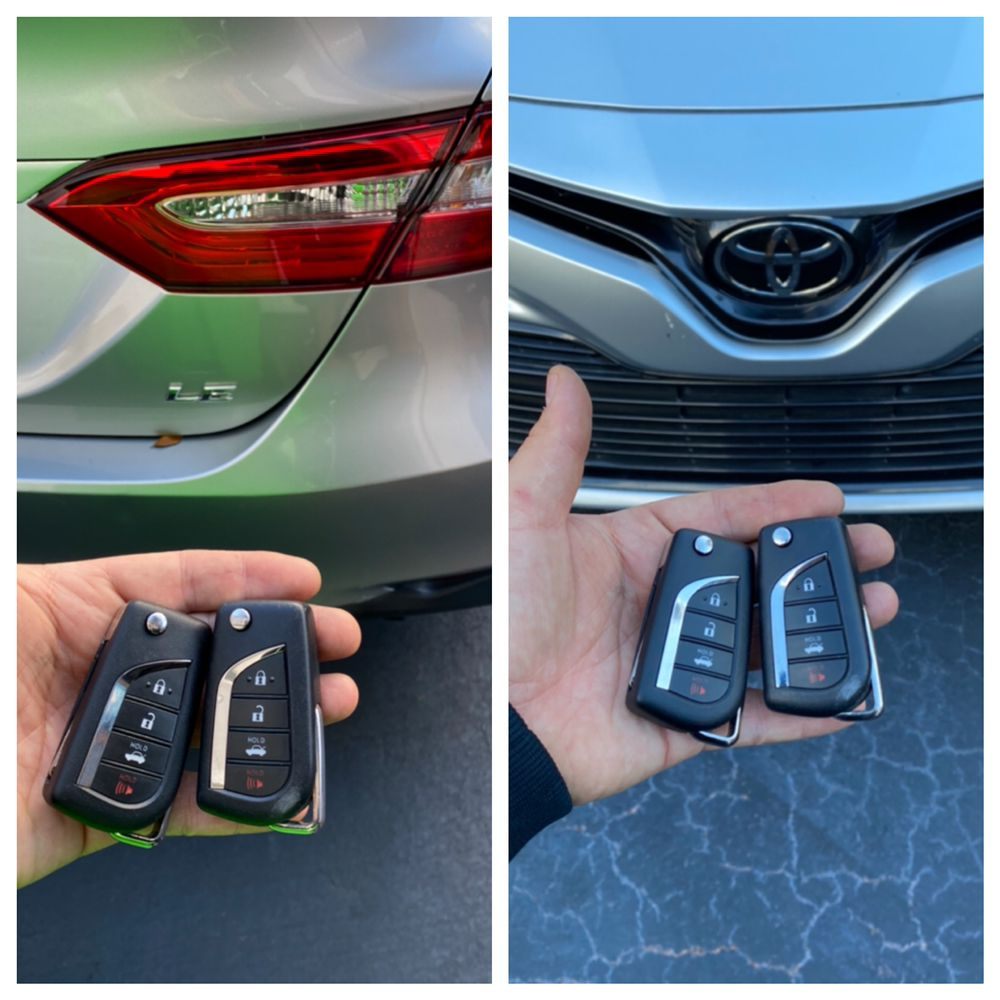
What South Florida does to a flip key
Heat is the biggest enemy. A key left in a hot car can reach temperatures that soften glue, warp the shell and weaken the spring. Humidity and salt air in coastal towns like Pompano Beach, Hollywood and Boca Raton speed up corrosion on the contacts and on the hinge pin. A key carried to the beach and dipped in salt water can fail within days.
Rental and fleet use also take their toll, since a key that has been passed from driver to driver sees far more flips than a personal key. Used car buyers tend to inherit an already worn flip key with a loose blade, and it usually fails soon after purchase. Snowbird cars can sit for months, and the fob battery can die in that time.
A simple habit helps a lot. Do not use the flip button as a fidget. Hold the blade as it folds, rather than letting it slam into the case. And do not hang the key on a heavy ring that swings against the ignition cylinder.
Repair options: shell replacement or a new key
When the housing is cracked or the hinge is gone but the electronics still work, the most economical route is usually a shell swap. We move the circuit board and the chip into a new case, fit the new blade and test everything. The key behaves exactly as it did before, and in most cases no reprogramming is needed because the original chip is kept.
When the electronics have failed, or the chip is damaged, the key needs replacing. A new flip key has a new chip and a new remote, and both must be programmed to the car. The blade is cut to match, and for many modern flip keys it is a high security cut, which we explain on our page for laser cut and high security keys.
Which is right for you depends on what is wrong. We look at the key first, tell you honestly which option makes sense and then do the job. We would rather repair a good board than sell you a new key you do not need.
Call Pro Locksmith at (954) 406-8266. Tell us the year, make and model and where the car is parked, and we will confirm what your vehicle needs before any work starts.
Cutting the blade
Flip key blades come in more than one style. Some are standard edge cut, and many are high security keys with a cut milled along the side of the blade. Ford’s flip keys of the later 2010s, for example, use a high security blade that is also found on smart key emergency blades. Different cars use different blades, and those that look alike can differ in ways you cannot see.
We cut on site with portable machines. If you have the old key we copy it. If you have lost it, we decode the lock or use the vehicle’s code, depending on the make. This is the same skill we use when replacing all lost car keys.
It is also worth knowing that a correctly cut blade with the wrong chip will turn the ignition but not start the engine. We check both together every time.
Programming the chip and the remote
Programming a flip key has two parts. The chip lets the engine run, and the remote controls the doors and trunk. These can be programmed together by a diagnostic tool, or on some cars the remote function is added through a set of steps done inside the car. Many cars need the tool for the chip regardless.
The method varies by brand. Some Hyundai and Kia models can be programmed by a mobile locksmith with the vehicle present, and ownership proof is normally required. Volkswagen products often need an advanced tool or the dealer for security data on some models. General Motors vehicles of this era may use a timed relearn, which wipes earlier keys, so every key must be with us for the job. Our key programming page explains the types of programming in more detail.
If the car is a newer model that is restricted to dealer-level equipment, please read the dealer-level requirements box on this page. We say so plainly when that is the case.
One flip key left versus none left
When you have one working flip key, we copy its cut and add a new key. The existing key usually keeps working, though some systems require all keys to be present because the programming resets the list. We explain which applies to your car before we begin.
When you have no key at all, the job is more involved. We cut a blade from the lock or from a code, then gain security access to the car to teach it the new key. On some brands this means a waiting period, on others a code read from a module, and on a few it is dealer only. A car with no key and no spare also loses the ability to compare the old remote function, so we test everything after programming.
We strongly recommend making a spare before the last flip key is lost. A key with a worn hinge is a warning sign that the next failure may be total.
What we need from you
For any flip key job we need proof that the car belongs to you and a way to identify the car. A registration or title matching your photo ID is the usual standard, and the VIN is found on the dash at the bottom of the windshield and on the driver door jamb. These let us confirm the exact key before cutting or programming.
Please bring any key you have, even if broken. A flip key with a snapped blade or a cracked shell still has a chip we can use, and it helps us identify the type. If the blade is stuck in the ignition, tell us on the phone, because we handle that first with our broken key extraction service.
Tell us the trim if you know it, and send a photo of the dashboard if you can. A start button means a different key than a round ignition cylinder.
How a flip key visit works
You call with the make, model, year and location. We confirm the details by VIN, talk through what the job involves and send a technician. Because we are mobile, the car stays where it is.
At the car, our technician checks ownership and the VIN, looks at the existing key and decides whether a shell swap or a new key makes sense. Then we cut, program and test. We test the blade in the ignition, the chip with the engine, and each button on the remote. We also check any spare keys you have.
We serve Fort Lauderdale, Hollywood, Pembroke Pines, Coral Springs, Plantation, Pompano Beach, Boca Raton, Miami, West Palm Beach and everywhere in between. The work is done at your driveway, your office lot, a parking garage or roadside.
Immobilizer details that matter with flip keys
Some brands handle flip keys in ways owners do not expect. General Motors relearn procedures clear previous keys the moment the first new key is programmed, so every key you want to keep must be present for the whole visit. Honda all keys lost jobs also remove old keys from memory.
On newer Fords, manufacturer credentials replaced the old ten minute security delay from the 2020 model year, which is why newer Fords can be dealer-level. Toyota’s chip changes happened model by model, so we never assume one year fits all. Nissan and Chrysler systems often involve a PIN read from a control module.
For flip keys the most common surprise is simply that the car refuses a new key even though it looks right. Wrong chip, wrong frequency or a key already paired to another car are the usual causes, and a careful check by us finds the answer.
Used and online flip keys
Online listings for flip keys can look like a bargain. Some are fine, many are not. A used flip key is probably paired to another car, and on many brands that cannot be undone. A cheap new one can have the wrong chip, a different frequency or a case that fits poorly and falls apart in weeks.
If you already have one, show it to us before you pay for programming. We can tell you whether it matches your car. If it does, we program it. If it does not, we tell you plainly.
The same advice applies to remote only repairs. A button that stopped working is often just a worn pad, and a cleaning or a new pad solves it without any programming.
Battery and everyday care
Most flip keys use a small coin battery that is accessible by opening the case along the seam. Replace it about every couple of years or as soon as range drops. Open the case carefully, since the plastic is brittle in older keys, and note the battery orientation before removing it.
Keep the key out of the sun on the dash. Rinse and dry it if it gets wet from a swim, and do not press the flip button underwater. Use a smaller key ring so the weight does not twist the ignition cylinder. If the blade ever feels loose, treat that as a warning and have it looked at while the electronics still work.
A little care means the difference between a small repair and an emergency call.
One more habit is worth building. Once a year, press every button and fold the blade a few times while you are standing next to the car. If anything sticks, rattles or feels different, you have found the problem on your own schedule instead of in a parking lot after dark. Keep your spare somewhere safe at home, not in the car, and check its battery at the same time. A spare that has sat in a drawer for years can have a dead battery and a stiff hinge, so it is worth knowing before you depend on it.
If you drive a rental or a fleet vehicle with a flip key, ask the owner how many keys exist and where each one is kept. Many fleets track their keys on a board, and a key that is missing from the board is the first sign that a replacement is coming.
When a dealer visit might be needed
Most flip keys can be handled at your car. A few newer vehicles, especially ones using manufacturer credentials or server based registration, are dealer-level. The dealer-level requirements box on this page lists the limits we work under.
If your car is on the dealer side of that line, we say so on the phone, before a technician spends time on the road. If it is not, we do the work on site and you drive away with a key that works.
Common questions
Can you fix my flip key instead of replacing it?
Often yes. If the case is cracked, the hinge is loose or the spring has snapped but the electronics still work, we move the circuit board into a new shell and fit a new blade. The original chip stays, so reprogramming is usually not required. If the board itself has failed, a new key is needed.
Why does my flip key blade not pop out?
The spring has usually weakened or snapped, or dirt has jammed the hinge. Heat and thousands of uses wear the spring over time. Do not force it, because that can crack the case. Bring it to us and we can usually replace the internal parts or move the electronics into a new shell.
Is a flip key a smart key?
No. A flip key goes into an ignition cylinder and turns, with the blade folding into the fob. A smart key works by proximity and starts the car with a button. Some cars offer both styles on different trims. We check the VIN and the dash to see which one your car uses.
I lost my only flip key. What can you do?
We cut a new blade from the lock or by code and then program the chip and remote using the right security access for your car. Some brands add a waiting period or a code read from a module, and some newer models are dealer-level. We confirm ownership first and explain your car’s route before starting.
Will my old flip key still work after programming a new one?
On many cars it does. On some systems, programming first clears the key list, so every key you want must be present. General Motors and Honda jobs are known for this behavior. We tell you which applies to your car and ask you to bring all your keys.
Can I buy a flip key online and have you program it?
Maybe. Please show it to us first. A used key is often locked to another car, and a cheap new one may use the wrong chip or frequency. If it matches your car, we can program it. If not, we say so before any work, so you do not spend more than you need.
Why does the key turn but the car will not start?
The immobilizer is not accepting the chip. The blade may be cut correctly but the chip may be the wrong one, unprogrammed or damaged. Ford blades that look alike but use different chips are a classic case. We test the key and the car on site to find the exact cause.
Do you come to my location?
Yes. We are a mobile service based in Fort Lauderdale, and we serve Broward, Miami-Dade and Palm Beach County. We come to your car, home or business, so there is no towing. Give us the make, model, year and exact location when you call and have your ID and registration ready.
Call Pro Locksmith at (954) 406-8266. Tell us the year, make and model and where the car is parked, and we will confirm what your vehicle needs before any work starts.