

A remote head key puts the metal blade, the immobilizer chip and the lock and unlock buttons into one plastic head. When one of those three parts fails or the key is lost, we come to your car anywhere in Broward, Miami-Dade or Palm Beach County and sort it out on site.
What a remote head key actually is
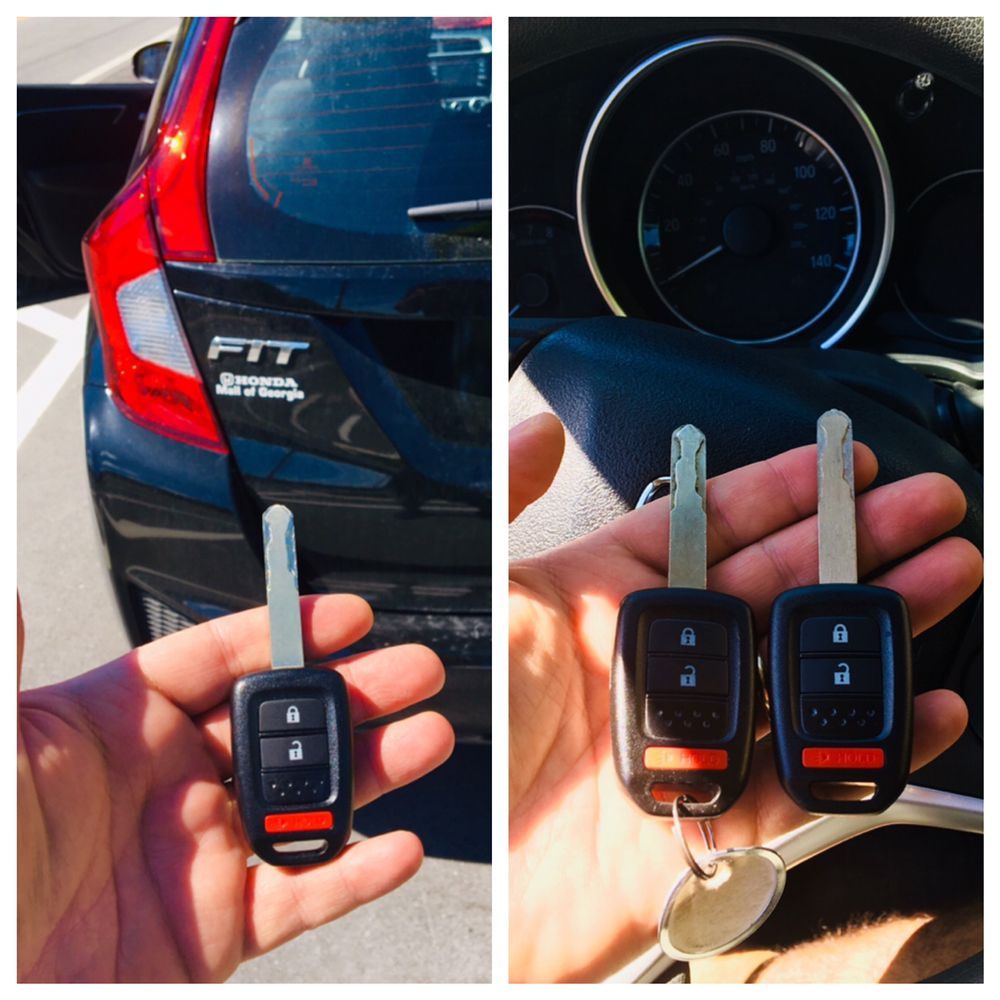
A remote head key is a traditional-looking car key with the remote control built right into the plastic head. You hold one object, and it does three separate jobs. The metal blade turns the ignition or the door lock. A small immobilizer chip inside the head proves to the car that the key belongs to it. And the buttons on the head lock, unlock, open the trunk or sound the panic alarm.
People often call these keys by other names. Some say a keyless entry key, some say a key with remote, and some just say the thing with the buttons on it. They are all talking about the same family. If your key has a blade you insert into a keyhole and buttons on the head, and you do not push a start button on the dashboard, you almost certainly have a remote head key.
In our daily work this is one of the most common keys we handle in South Florida, because so many sedans, crossovers and trucks from roughly the mid 2000s through the late 2010s were sold with exactly this design. Understanding how it is built makes it much easier to understand what can go wrong with it and what a replacement really involves.
How a remote head key differs from the other key types
The easiest way to place a remote head key is to compare it with its neighbors. A plain standard key without a chip is only metal and has no electronics. A transponder key has the immobilizer chip but no buttons, so the remote is a separate fob on your key ring. A flip key has a blade that folds into the housing, and a push to start smart key never goes into a keyhole at all during normal driving.
The remote head key sits in the middle of that ladder. It keeps the fixed blade of the older design and adds the convenience of built-in buttons. Because the blade does not fold, the head is usually a bit slimmer and the key is a bit more rugged than a flip key, which is one reason fleets and work trucks stayed with it for so long.
Remote head versus separate remote
On many trucks and older sedans, the buttons are on a separate fob and the key is a plain transponder key. On others the same model has the buttons in the key head. Both can exist on the same model line in the same year, depending on trim. That is why we always look at your key and your ignition rather than going by the model name alone.
Remote head versus integrated key fob
Some Chrysler, Dodge, Jeep and Ram vehicles use an integrated key fob that has no fixed blade and slides into the ignition as a block. It behaves like a remote head key in many ways, but it is cut and handled differently. We cover those on the make pages for each brand.
Which makes use remote head keys
Remote head keys were used by almost every major brand at some point. Our model data shows them clearly on Ford, where cars and crossovers such as the Escape, Edge and Fusion used a remote head transponder key for many years before flip keys and smart keys took over. On Lincoln, models like the MKZ and MKX followed the same pattern.
General Motors used them widely. Chevrolet models such as the Equinox, Malibu, Camaro and Traverse, GMC models such as the Acadia and Terrain, and Buick and Cadillac models from the 2000s all appear in our data with remote buttons built into a chipped key head. On many of these models a higher trim has a push-button smart key instead, so the trim matters.
Toyota used remote head keys on models like the Camry, Corolla, RAV4, Highlander and Venza, again by trim, with smart keys on higher-end versions. Subaru used a chipped key with built-in buttons on the Outback, Legacy, Forester, Impreza, Crosstrek and BRZ for a stretch of the 2010s. And Chrysler, Dodge and Jeep used remote head keys on models like the Sebring, Caliber, Avenger, Compass and Wrangler.
The German brands use something similar in spirit. Many Audi, BMW, Mini and Mercedes-Benz keys from the 2000s and early 2010s are a remote fob with an emergency blade, and some are a slot-in design. We treat those as cousins of the remote head key, though the programming is a different animal.
Why we always confirm the exact key before cutting
A key that looks right can still be wrong. Our model data marks many remote head entries as a general statement rather than a certainty, because manufacturers often changed the key partway through a generation or offered a different key on a base trim. So when we say that a certain model usually uses a remote head key, we mean most of them, not every one.
That is why we confirm by VIN and by looking at your car. We check how the car starts, whether there is a keyhole or a button, how many buttons the old key had, and what the existing key looks like. Only then do we choose the key to cut and program. It takes a few minutes, and it prevents the most expensive mistake in this trade, which is cutting and programming the wrong key.
If you can send us a photo of your current key before we arrive, that helps us bring the right part. If you have lost every key, the VIN and the car itself tell us what we need.
The three parts we have to deal with
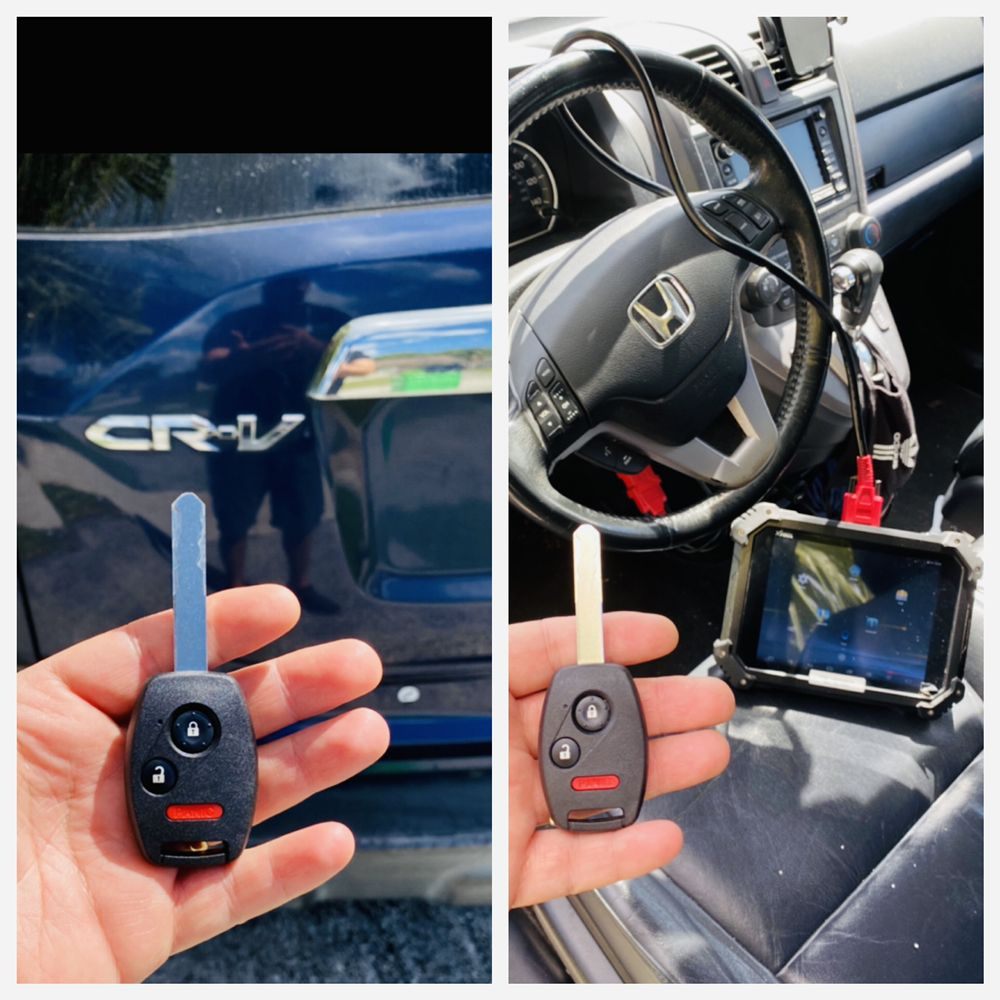
Replacing a remote head key is really three jobs in one visit, and each one can fail on its own. Knowing which part has failed saves time and sometimes saves you from buying a whole new key.
First there is the blade. It has to be cut to fit your ignition and your door lock. Second there is the immobilizer chip. It has to be recognized by your car or the engine will turn over and then stop, or not turn over at all. Third there is the remote. It has to be paired with the car’s receiver so the buttons work.
- The blade is a mechanical job and is cut to your car’s key code or copied from a working key.
- The chip is an electronic job and needs a diagnostic tool connected to the car’s data port.
- The remote is also an electronic job, and on some models it is learned in the same session as the chip, while on others it is a separate step.
- A key can work for one of these parts and fail for another, which is common with online keys of unknown origin.
Lost all keys versus adding a spare
These are two very different situations, and the good news is that you still have one working key. When a working key exists, we can add a spare by copying the information the car already knows. The process is usually smoother and involves less risk to the car’s computer.
When every key is gone, the situation changes. We have to identify the car from the VIN, cut a new blade without a pattern, and then program a new chip into the car’s memory with the original keys missing. On many cars, the old lost keys are erased from memory during that process, which is actually a good thing if your keys were stolen. You can read more on our page about lost all car keys replacement.
The practical advice we give every customer is simple. If you are down to one key, make a spare now. The difference between making a spare and replacing a full set after a loss is large, both in the work involved and in the stress of being stuck.
Call Pro Locksmith at (954) 406-8266. Tell us the year, make and model and where the car is parked, and we will confirm what your vehicle needs before any work starts.
Programming the chip and programming the remote
People are sometimes surprised that there are two kinds of programming. The chip programming lets the car start. The remote programming lets the buttons control the doors. They are related, but they are not the same step, and the order and method vary by make.
The exact order and method vary by make. On some vehicles the chip and the remote are learned in one session with a professional tool, and on others they are separate steps. Some older Ford systems also impose a security delay of about ten minutes before the car accepts a new key, and we plan our visit around that wait.
What matters to you is that when we leave, the key starts the car, the buttons work, and a second key also works. We test each one before we call a job finished. You can read more about the process on our key programming page.
What South Florida does to remote head keys
Our climate is hard on small electronics and hard on rubber. A remote head key lives in a pocket, a purse, a cup holder, a beach bag or a boat, and it gets heat, humidity and salt air all year. Over time those conditions wear out the rubber button pads, loosen the plastic seams, and can corrode the tiny contacts that connect the battery to the circuit.
We also see what the sun does to a key left on a dashboard. A dark dash in August can reach temperatures that warp a plastic housing and shorten battery life. A key that is dropped in a pool or at the beach may still work for a few days and then fail as moisture sits inside the head.
Salt air matters for the blade as well. A blade that has been in salty air for years gets rough, which makes the lock stiff, which makes you force the key, which bends the blade. If your ignition feels sticky, deal with that early, because a damaged ignition and a worn key wear each other out.
Common failures and what they usually mean
Most remote head key problems fall into a few patterns. Here is how we read them when you call us.
If the car starts but the buttons do nothing, the chip is fine and the remote side is the problem. That is often a dead battery, worn contacts or a remote that lost its pairing. If the buttons work but the car will not start, the chip is the problem, or the car has lost the key from memory. If neither works, the key may be damaged beyond repair, or the car may have a separate fault.
Worn button pads and cracked housings
The rubber pads on the buttons wear through, and the plastic shell can crack around the key ring hole. In many cases we can move the working electronics into a fresh shell instead of making a whole new key, as long as the circuit board and chip are in good shape and the shell matches your key.
Bent or worn blades
A blade that is worn smooth may turn in the door but jam in the ignition, or the other way around. A worn key should not be copied again, because a copy of a worn key is worse than the original. We prefer to cut from the car’s code so the new key is crisp.
Chip trouble after a drop
A hard fall can crack a chip or break the tiny glass capsule on older designs. If the car stopped recognizing a key that was dropped, a replacement chip may be needed. We can usually tell with a short test using our diagnostic tool.
Key cutting for remote head keys
The cutting side of a remote head key depends on the blade style. Many keys from this era have a conventional edge-cut blade that is cut along its edges, like a house key. Others, particularly on later models, use a high security blade that has a wavy channel milled into the side of the blade. Those need a different cutting machine and more care. Our page on laser cut and high security keys explains how that style works.
We work from your key code when we have it, from the lock itself when needed, or from a working key when one exists. Whichever method we use, we test the new blade in the door, the ignition and, if your car has one, the trunk or glove box lock. A blade that turns the ignition but sticks in the door is not finished.
Subaru offers a good example of why the blade matters. Our data shows that some Subaru models of roughly 2008 through 2014 used a high security laser-cut key with a chip, while the same models later returned to an edge-cut key with built-in buttons. Two keys that look alike from across the room can need very different cutting.
What we need from you
Because a car key is a security item, we always verify that you have the right to the car before making a key. That is standard practice in the trade, and it protects you as the owner.
We ask for a government photo ID, and proof that the vehicle is yours. That can be the registration, the title, an insurance card or a lease or rental agreement that lists you. We also need the VIN, which we can read from the dashboard or the door jamb. If the car belongs to a company, a letter or documents showing you are authorized are helpful.
If you are buying a car from a private seller and the seller gave you only one key, bring the paperwork you have and we can talk through it. If something does not add up, we will tell you plainly. We would rather ask questions than hand a key to the wrong person.
How a visit works
We are a mobile service, so the work happens where the car is parked. That could be your driveway in Plantation, a parking garage in downtown Miami, a marina lot in Fort Lauderdale or the shoulder of a road in Pembroke Pines. We cover Broward, Miami-Dade and Palm Beach counties.
When we arrive, we confirm your identity and ownership, then look at the car, the ignition and any key you still have. We explain what the job involves before we start, so there are no surprises. Then we cut the blade, program the chip, program the remote, and test every function. If you needed a spare, we make it in the same visit.
We finish by showing you how the key works, explaining any quirks of your model, and making sure old keys are handled correctly. If the old key was lost, we can talk about removing it from the car’s memory. For a general overview of this service, see our page on car key replacement and programming.
Used cars, rentals, fleets and snowbird vehicles
South Florida has an unusual mix of vehicles, and each has its own key story. Used cars bought from auctions or dealers often come with one key, and sometimes with a key that is not the original. Having a second key made soon after purchase is a smart habit.
Rental cars, ride share cars and company fleets tend to have a lot of hands on a small number of keys. Remote head keys in that kind of service wear out sooner, and the shells crack. If you manage a fleet, keeping a labeled spare and a record of which keys belong to which vehicle saves a lot of trouble.
Snowbirds often leave a car parked for months. A key battery can die while the car sits, and a car battery can die too. When the owner returns and the key does not respond, it can feel like a key failure when it is a dead battery in one or both places. We can check both and tell you which it is.
Online and secondhand keys: a word of caution
We are often called after someone bought a key online and could not get it to work. Sometimes that works out, and sometimes it does not. The usual problems are a wrong chip type, a remote that does not match the car, a blade that is cut incorrectly, or a used key that was already locked to another vehicle and cannot be reused.
A secondhand key can be a fine option if it is the correct part and is still unlocked. Many keys, however, are single-use. Once they are paired to a car, they cannot be reset for another. If you plan to buy a key yourself, call us first and we will tell you what to look for. We will also tell you honestly if the key you bought can be used.
Whatever you choose, it is wise to confirm that the key matches your vehicle by VIN and not just by model name, since the same model can have different keys in the same year.
Caring for a remote head key
A little care makes these keys last years longer. Replace the battery before it dies, not after. Most people notice the signal getting weaker, with the car needing a closer approach before it responds. That is the sign. Use the correct battery type for your key, and be gentle when opening the housing so you do not damage the seal.
Keep your key ring light. A heavy ring of keys hanging from an ignition puts weight on the key and the ignition cylinder, and over years that wears both. If you carry many keys, consider a short strap or a detachable ring so the car key is not hanging by itself.
Keep the key dry and out of direct sun when you can. Avoid leaving it in a car on a hot day or in a pocket while swimming. And keep a spare somewhere safe at home, not in the car, not in a magnetic box under the bumper.
When a dealer visit might be needed
For most remote head keys, an automotive locksmith can do all of the work. Some newer vehicles, however, need manufacturer-level access, such as online credentials or a server registration, that is controlled by the brand. When that applies, we say so up front, and the dealer-level requirements box on this page explains what we can and cannot do for each make.
Our general rule is that older remote head keys are straightforward for us, and the newest models need dealer-level tools more often. If your car is on the newer side, tell us the year and we will tell you whether we can help or whether a dealer is the right first stop. If a dealer is needed, we will not pretend otherwise.
If you are unsure, call and describe the car. A few questions are usually enough for us to tell you where the job will land.
Common questions
How do I know if I have a remote head key?
If the key has a metal blade that goes into a keyhole and buttons for lock and unlock on the plastic head, it is a remote head key. If the blade folds away, it is a flip key. If you start the car with a button and never insert a blade, you have a smart key. We can identify yours from a photo.
Can you make a remote head key if I lost every key?
Yes, in most cases. We identify the car by VIN, cut a new blade from the code or the lock, and program a new chip and remote into the car. Some newer vehicles need dealer-level access, which the box on this page describes. We confirm your ownership first.
Can you just replace the shell instead of the whole key?
Sometimes. If the circuit board and chip are healthy and only the case is cracked or the buttons are worn, we can often move the electronics into a new shell. We inspect the key first and tell you honestly whether a shell swap makes sense or a full replacement is the better path.
Why does my car start but the buttons do not work?
That points to the remote side, not the chip. The most common cause is a weak battery, then worn contacts, then a remote that lost its pairing with the car. We test the key, replace the battery if needed, and reprogram the remote if the pairing is gone.
Will my old lost key still work after you program a new one?
On many vehicles, the programming session removes older keys from the car’s memory, so a lost or stolen key will no longer start the car. This depends on the make. Tell us if a key was stolen and we will make sure it is handled correctly for your model.
Can I buy a key online and have you program it?
Sometimes, if it is the correct key and has not been locked to another car. Many online keys are the wrong type or already used. Call us before you buy, and give us your VIN, so we can tell you what to look for and avoid wasted money.
Do you come to me or do I bring the car?
We come to you. We are a mobile service covering Broward, Miami-Dade and Palm Beach counties, working at homes, businesses, garages and roadsides. If the car is not drivable or the keys are gone, mobile service means you do not have to tow it first.
Call Pro Locksmith at (954) 406-8266. Tell us the year, make and model and where the car is parked, and we will confirm what your vehicle needs before any work starts.